

I did say I would talk about the Hugo Nominations when the nomination statists page was released, and well… here we are. Worldcon23 dropped the data at the last possible second and damn, there is some controversy. Click here for a link to the PDF if you want to follow along.
If you aren’t interested in the Hugo 2023 controversy, do still feel free to scroll to the bottom of this post. I end up talking about the upcoming awards and post some links to some pretty good ‘best of 2023’ pages that are good for book recommendations.
Back on topic, and of course, there are people much more involved and knowledgeable about what happened than me talking about this, so I’m just going to give a quick overview, pull some quotes from the affected authors and then provide links to where people go over the implications and details much better than I can.
The basic gist is that some works were disqualified from going on the Hugo ballot. This isn’t unusual; in fact, it is very common in the Dramatic Presentation categories for a nominee to be disqualified in one because it ended up being nominated in one of the others. Here’s the page of nomination stats for the 2023 Best Dramatic Presentation Short Form that shows what this type of disqualification looks like:

As you can see, the 5th place nominee, ‘Severence’ Season One Episode Nine, The We We Are, was declared Not Eligible per section 3.8.3 of the Hugo Award Constitution, which states:
“If any series and a subset series thereof both receive sufficient nominations to
appear on the final ballot, only the version which received more nominations shall
appear” – Hugo Award Constitution
In this case, whilst the S1 E9 episode of Severence was nominated for the Best Dramatic Presentation Short Form, the entire first season was also nominated in the Long Form category, where it received more nominations, therefore, it appears on the ballot in that category and is disqualified here.
Similarly, on this same page we see that The Deep was also declared Not Eligible, and in the footnotes it is explained that this is because it was actually released in the wrong year. So far, all good and reasonable disqualifications, which are logical and consistent with decisions that have been made in previous years.
And then we get Sandman Episode 6: The Sound of Her Wings, which was declared Not Eligible because…
…well, no, there is no reason, it’s just ‘Not Eligible’. No explanation provided at all. To add insult to injury, the entire season of Sandman did receive enough votes to make it on the ballot in the Best Dramatic Presentation Long Form category, but it was disqualified there under the same rule as the Severence episode, because The Sound of Her Wings got more votes in this category. So yeah, Sandman got completely shafted for no given reason.
And it is not the only work or author to be mysteriously disqualified in this way. There were six such disqualifications in total, not including the stealth disqualification of Sandman in the Dramatic Long Form category. To be fair, one of them, a Chinese novelette called Color the World may have been published in the wrong year, but the other Chinese work affected, Fongong Temple Pagoda, should still be a 2022 publication and therefor eligible. Paul Weimer, a book reviewer, podcaster and author who was deemed Not Eligible in the Best Fan Writer category, posted the following comment on the Hugo Awards Official Site:
“I have sent an email to the administrators but I am going to be public here, because I should be.
Why was I, among other works and people, considered ineligible, without any explanation or even being informed of that ineligiblity?” – Paul Weimer
Click here for a link to the discussion which followed. It is quite informative about the whole situation… but we never do get a straight answer on why these unexplained disqualifications happened. The author of the post releasing these stats, Kevin Standlee, has been responding to questions, and whilst he hasn’t given a satisfactory answer, the main thing he is implying is that it has something to do with the agenda of the Chinese Communist Party. I’m mostly basing that off this quote:
“WSFS rules only apply when they aren’t superseded by a superior authority. That’s not explicitly stated in the WSFS Constitution, but it should be obvious.” - Kevin Standlee
Even though no-one working for the SFWA or Hugo Committee will explain why these works were disqualified or taken any responsibility, I think it becomes obvious it’s about CCP sensibilities when you take a look at the two most high profile authors affected, R. F. Kuang and Xiran Jay Zhao.
R.F. Kuang’s novel Babel won a lot of big awards, including the Nebula and the Locus Awards. It was a sure-in to be on the Hugo Ballot and pegged as a likely winner. As a source of that last bit, here’s a collection of random Reddit posts saying so. See, height of journalism right here folks.
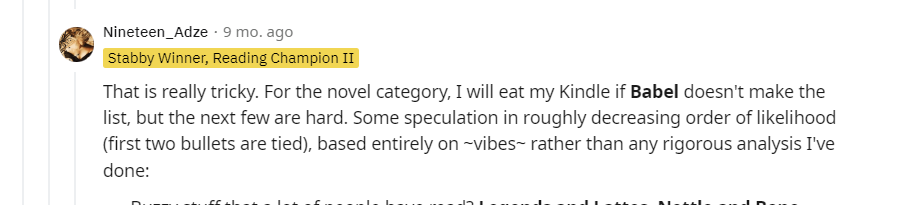

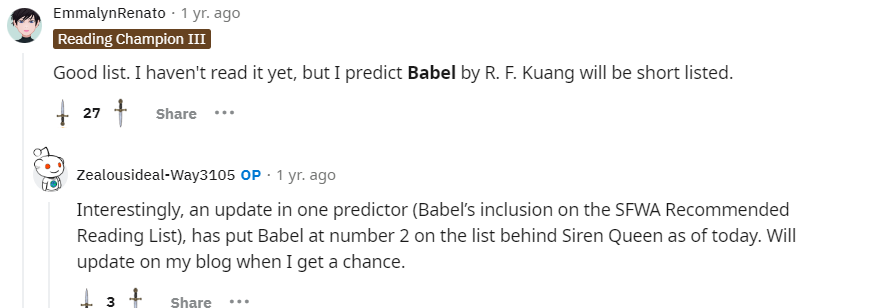

So, everyone was expecting Babel to be on the ballot, and it was quite a surprise when it wasn’t. Now we know that actually, Babel did receive enough votes to be on the ballot, but was disqualified for no reason. Meanwhile Xiran Jay Zhao was on their second year of eligibility for the Astounding Award for Best New Writer. They were nominated in this category last year, where there was no question about their eligibility. The only way an author who was eligible for this award in their first active year can be ineligible for their second year, is if they win the first time they’re nominated. Xiran Jay Zhao was not the winner of this award last year, so there should be no way for them to be ineligible this year, and yet there is an asterisk next to their name and no further explanation.
Kuang and Zhao are American and Canadian authors of Chinese descent. Both of them have been critical of the CCP, with Kuang having publicly spoken about her father’s involvement in the Tiananmen Square Massacre and Zhao often vocally calling out the ongoing Uyghur genocide in China. Also, Zhao happens to be non-binary so that could be a factor. There are plenty of reasons why both these writers would be seen as ‘undesirable’ by the CCP, and with Standlee’s comment about Worldcon rules having to give way to local laws in mind, it is not hard to imagine they may have been left off the ballot out of fear they might have won and said something controversial in their winning speech. Though of course, since we haven’t been provided with an actual explanation for this whole kerfuffle by anyone responsible for the awards, we’ll never be able to say for sure. Though… I’d bet money on it.
Both Kuang and Zhao have commented on these events. Here’s Kuang’s a statement from Kuang posted on her Bluesky:
“I Initially planned to say nothing about Babel’s inexplicable disqualification from the Hugo Awards. But I believe that these cases thrive on ambiguities, the lingering question marks, the answers that aren’t answers. I wish to clarify that no reason for Babel’s ineligibility was given to me or my team. I did not decline a nomination, as no nomination was offered.
Until one is provided that explains why the book was eligible for the Nebula and Locus awards, which it won, and not the Hugos, I assume this was a matter of undesirability rather than ineligibility. Excluding “undesirable” work is not only embarrassing for all involved parties, but renders the entire process and organization illegitimate. Pity.
That’s all from me. I have books to write.” – R.F. Kuang
Xiran Jay Zhao’s has made a few social media posts about this, but I’m going to share their Tiktok post (well, Youtube now… because it got taken down from Tiktok for ‘violating community standards’. Yeaaaaaah). Click here to watch. They’re primarily a Youtuber, and they make some really interesting videos discussing Chinese history and depictions of China in pop culture, so would recommend them by the way.
Now, for a post that was just going to briefly touch on this issue, this is starting to get long, so I might cut myself off here. I am after all very late to the party, and others have already covered this better than I can. The authors affected by this have been sharing information and are good sources. One video I learnt a lot of this from was Daniel Greene’s summery, and the two posts he cites as sources are very in-depth and explain a lot. Click here for a post by Cora Buhlert, or click here for one from Mr. Phillip’s Library. These posts both talk more about how the numbers are weird, how there’s some other omissions that seem weird (N.K. Jemisin really didn’t even make the long list? I mean, The World We Make wasn’t her best work so it’s plausible, but it was still a good entry in an award worthy series, and she is very well known in the SFF community. Seems weird she wouldn’t get the votes. And what about Nghi Vo’s Siren Queen? Have not read it, but it seemed really big. There could be something to Buhlert’s speculation about whether the voting drop off suggests finalists were just deleted, though as she herself said, it’s a flawed idea.), and the whole saga with Worldcon key leader Dave McCarty being an asshole to people asking questions. Which Mr. Philip made an entirely separate post about, that you can find here. McCarty and Standlee have both resigned now, which is a good start in addressing this situation, but still not enough. As Zhao said, we need to make a fuss over this.
This whole event has given me a lot to think about regarding the Hugos. For years, I have really looked forward to the award season because of the Hugos. being able to join Worldcon and nominate and vote and then follow along with everything has always been a lot of fun. It’s also been good for my blog, as the posts I do reviewing Hugo nominees are among my most consistently viewed. Though, my review of A. E. van Vogt’s Slan is my most viewed post, so maybe it’s a good idea to turn my focus away from the Hugos. This whole shitty thing has left a bad taste in my mouth. Like, they knew they were doing something shitty. Normally these stats are released days after the awards, but they were delayed as long as possible in the hope that people would have moved on. But we haven’t. As Zhao said, we need to make a fuss. There is no future for the Hugos if we allow them to become such a farce.
I’m not exactly sure what needs to happen, but requiring any disqualifications to be fully explained is a good start. And also the Hugo Award Committee needs some power to reign in a Worldcon that looks like it will go rouge. There were a lot of concerns about Changdu as a host, and what influence the CCP would have on the awards. After all, censorship is one of their big things. They’ve got a good firewall you’ve probably heard of. Whilst in the end I’m not surprised that a con hosted in China was ruined by censorship, I’m disappointed. There is a huge science fiction fandom in China, and a lot of people saw this con as a chance for Chinese SF to be promoted to the world and for fans in China and the West to come together. This could have been a good thing if not for the obvious political problems.
My biggest worry now, is that if we don’t learn from this and make changes, we could see the same sort of thing happen in 2028 if Uganda wins their bid for a Worldcon in Kampala. A Worldcon in Africa is a great idea that needs to happen soon, but Uganda? I don’t think they’re as infamous for censorship as China, but ‘promoting homosexuality’ is punishable by 20 years in prison there. And a lot of Western science fiction these days is very queer. Would a Ugandan convention organizer be at risk of jail or of getting murdered if a bunch of queer authors speak at their event and promote books with queer characters? Would they want to risk it? I think if local laws are going to trump the rules of the Hugo Awards and Worldcon, then this event cannot be held in places where the local laws are a problem, both for the integrity of the awards and the safety of the event organizers.
And, once again, I have started rambling. I set out to do a quick summery and ended up with all this. I’m not quite ready to jump on the bandwagon and say that the Hugos are dead and irrelevant now. But as Kuang said, this type of behaviour is not indictive of a legitimate award process. If nothing is done to correct what happened and prevent a similar event happening in the future, then the Hugos will die.
Which, brings me to this year’s Hugos. Hosted in Glasgow, Scotland, with a different Worldcon Committee running the show. (Each Worldcon is organised entirely by a local team in the host city. Which is why Changdu was able to screw things up so badly, but also a strong reason why we are unlikely to see the same issues happen in Glasgow.) I am willing to give the 2024 Hugos a chance and follow along for now, though that could change if the response to the 2023 Hugos proves unsatisfactory. Also, I have not joined this Worldcon and will not be voting and nominating, but that’s because money is tight at the moment, not out of protest.
Whether or not you’re interested in the Hugo Awards, or any other upcoming awards, this time of year is always good because recommended reading lists are put out in anticipation for the awards. These are a good way to find some really good short fiction, so here’s a couple of lists.
Rocket Stack Ranks’s Best of the year for 2023 has tons of well reviewed novellas, novelettes and short stories listed, along with synopsis, read times and links where possible. Find it here. I love using Rocket Stack Rank to find short fiction to read; it’s really easy to skim through and find something that catches your interest.
Locus has also released their 2023 recommended list, which has quite a few novels, collections and anthologies, art books and non-fiction in various genres alongside an impressive list of shorter fiction. Find it here. There are actually a lot of novellas on the Locus list that I haven’t heard of yet that look really interesting, so I’ll probably be picking up some.
And finally, there is the Tor.com 2023 Reviewer’s Choice post over at Reactor Magazine (Confusing? Nah, Tor.com has just started renaming itself Reactor Magazine.) Here the Tor.com/Reactor reviewers talk about their favourite new releases of 2023. It’s a really great page for in depth information about 2023 novels. Find it here.
Also, it didn’t make it onto any recommendation lists, but my short story The World in a Raman Cup was published in Analog Science Fiction and Fact and is therefore eligible for a Hugo wink wink, nudge nudge. I also have another short story, Hell and a novella Neighbor that are eligible, but I’m a bit more realistic about their chances of being nominated.
Okay, that’s my two cents on the matter. I’ll be following along for any new developments, and also will be going out of my way to read the ineligible works as soon as I can. In the meantime, I hope everyone finds something good to read from those best of lists.
~ Jayde
 Jayde Holmes
Pingback: But the emails! More information on the 2023 Hugos comes to light. – Jayde Holmes