

Last month I dropped a lot of lore with the Towers of Knowledge, this month we’ll go back to basics with more bugs. One thing that inspired this world was that I feel not many alien stories address the possibility of incompatible biochemistry. The fact that life in the Green Human World and the Black Drid World is mutually toxic shapes everything about my character’s lives. Today though, we’re going to consider the possibility that toxins designed to work on life unlike that on Earth may have some unintentional benefits for humans. I also wanted to dig a little deeper into some of the constraints on Drid telepathy. Enjoy.
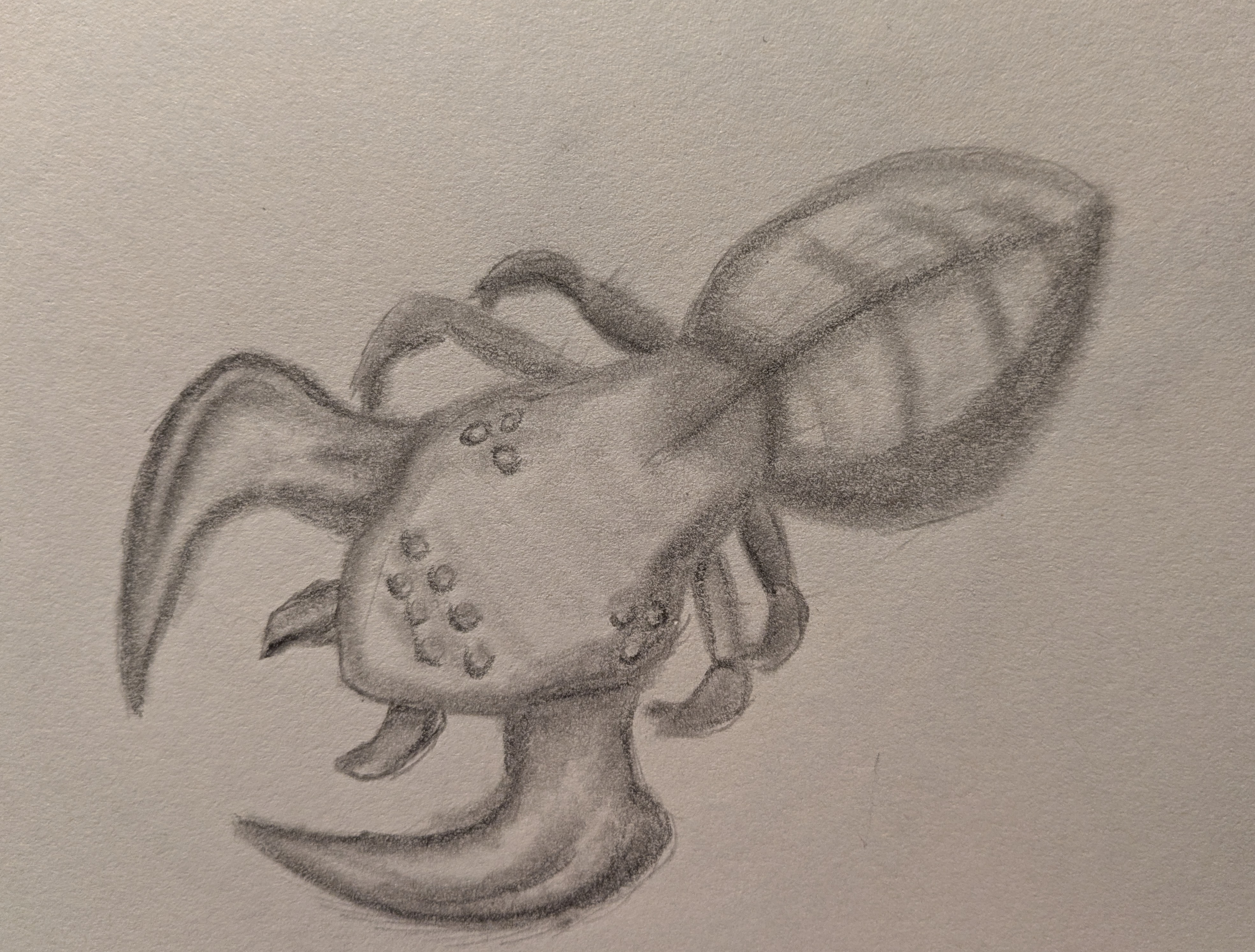
Name: Category Two Bugs
World: Black
Material: Shell
Thought Type: Unconstrained
Species Type: Bug
Habitat: All Black World Habitats
In both the Green World and the Black World, bugs form an important role in the ecosystem. They exist in unimaginable variety in both worlds, sustaining many food chains and playing a role in pollination and soil creation. In both worlds, there is controversy on where the ‘bug’ type ends and other types such as crustacean, mollusc, worm and jelly begin. Black World bugs are divided into three distinct categories based on the number of segments of their bodies. Though a fourth category, consisting of two-segmented bug-like creatures with a more crustacean-like body construction, is put forth by some naturalists.
This entry will provide an overview of Category Two bugs, which are often compared to the spiders and scorpions of the Green World in build, but are more like Green World insects in size and niche. Whilst they are not as common as Category One Bugs, they are still too varied and numerous for this volume to list individual species.
Category Two Bugs are the most similar bugs to Green World Bugs, as they have segmented bodies that are covered in a chitin shell, rarely grow larger than their Green World counterparts, and always have antennae. However instead of having three body segments and six legs like Green World Bugs, they always have two body segments, a head and an abdomen, and four legs. They can have many common bug attributes, such as wings or stingers, but they all lack silk. They also have telepathy, unlike both Green World Bugs and Black World Category One Bugs.
Whilst category two and three bugs do possess telepathy, it is generally accepted that they cannot be controlled by Drids, though Drids can passively perceive sensory information from bugs they have connected with. There are however rare accounts of Drids being able to control bugs. The most famous of which is the Memory of the Ancient Swarm-Master. This is a faded memory that has been passed around the Drid Forests for the past fifteen thousand years, of a Drid who was able to control a variety of category two bugs for use in Forest warfare.
As with all Drid memories that predate living Drid memory, details and context have been lost to the point where nothing about the memories can be confirmed, and many Forest’s hold contradictory versions of this memory. It is entirely possible that the ‘memory’ is an ‘imagining’* rather than a memory, though most Drid historians argue it would not have survived so long if it did not reflect reality. It has also been proposed that the inconsistencies in the memories, which include core details like the location of the Swarm-Master and their sex, indicate that there were at least two swarm-masters in the ancient past, though it seems unlikely such a rare gift would manifest twice within the same time and place. This has not stopped modern Drids from imagining what a conflict between multiple swarm-masters would be like.
It is unsurprising that legends of swarm-masters able to control bugs telepathically are so strong in Drid culture, as category two and three bugs can devastate Drid Forests, and swarm-keepers are highly regarded members of society who can protect their Forest or release dangerous bugs into enemy Forests. The most well-known category two war bug is the bark-ripper, a large crawling bug that preys on creatures made of the flesh/mould hybrid material, including Drids, and has claws and mandibles that can rip bark from smaller trees, such as Drid host trees. Bark-ripper eggs are also notoriously difficult to find, and release a chemical that repels most of the creatures Drids keep around their trees as pest control. Bark rippers have been known to wipe out entire Drid Forests in the past. On at least one occasion, they managed to return to the Forest that unleashed them and destroy it. They are so destructive, that most Forests between the Stalax and Ramparossa Rivers have signed a treaty banning them, and the holdout Forests are treated as pariahs. They are however a constant plague on the West Coast Forests.
Category two bugs are not all destructive. They are known to be chemically complex, with a range of toxins and shooting acids for defence. This results in them being used in a variety of medicine for both Drids and Humans.** The most prized medical bug amongst Humans is the silverfly, a small flying insect, the female of which has an abdomen filled with a glowing silver substance that she uses to create holes in the body of farei-like creatures to lay her eggs. This acid when used on a Green World organism will eat away at cancerous tumours, but cause little to no harm to on regular flesh or non-spreading tumours.

Silverflies used to be common in all sub-tropical Black World environments, but due to overhunting can now only be found in the Black Canyon. Even there, they are becoming increasingly rare around the edges of the canyon, requiring those seeking a cure to venture deeply into the uninhabited canyon. Many never return. The exception is the edge of the canyon that boarders the Kingdom of Noolat, which only allows hunters to gather the flies for one year out of every eight. On this Year of Healing, the so-called City of Medicine, Callagnat, becomes filled with both the sick and the opportunistic.
There are so many Category Two bugs, that even Drids are constantly discovering new ones. For more information about all Black World bugs, refer to Greatest Bug Expert of the Western Forests’s Encyclopedia of Black World Bugs. This book, currently in its 74th edition, is the life work of the renowned titular Drid Naturalist, written and translated along with generations of Human naturalists.
*A Drid term for story. Drids do not like to compare their stories with Human stories but instead treat them as scientific hypothesis.
** Note that whilst Black World plants and animals can provide medicinal benefits to Humans, they also cause Black World toxicity. Apothecaries worldwide have found many creatures that are capable of curing deadly Human diseases, but the quantity needed can risk killing the patient with the side effects.
 Jayde Holmes