

Welcome back to the World of Green and Black. Today, we’re going to learn how baby Drids are made. Pollinators were mentioned briefly in The Strongest in the Forest, but I think now’s a good time to provide more information. Not too much information though. Some things are a secret, and not for Human knowledge.
__________________________________________________

Name: Pollinators
World: Black
Material: Flesh
Thought Type: Unconstrained
Species Type: Rodent
Habitat: Drid Forests. Domestic.
Pollinators are common in Drid Forests, but even Drid naturalists who value collaboration with Human naturalists are secretive about these creatures. Pollinators are essential for Drid reproduction, and leaders in Forests bordering Human settlements often see limiting Human knowledge and access to pollinators as necessary for their security. This fear is not unwarranted; The Great Forest War was started by Ramparossan Lords poisoning pollinators in a terraforming attempt. Despite this, some information about pollinators has been gained by Humankind over the centuries.
We shall begin this article with information that has been voluntarily shared by the Forests. The Strongest of the Lower Stalax River Forest famously volunteered a basic explanation of Drid reproduction when explaining how she came to raise the offspring of the Highest of the Keepers of the Empty Forest.
“The only difference between a male and female Drid is the shape of our flower buds, and we have no way to combine the two flowers together. The pollinators transfer the different seeds from both flowers and combine them to create an embryonic Drid. If the pollinators are not directed by us, they will stay in one grove, moving randomly from host-tree to host tree. Less civilized Forests allow this behaviour, but this presents too big a risk of accidental incest for us. We guide the pollinators between two trees belonging to adults genetically and physically distant, then send it to an empty host tree far away from either parent, to be raised by a trusted mentor. Drids maintain relationships with their parents, but by being raised by an unrelated mentor, they avoid the risk of uncontrolled pollinators breeding them with their parents.”
Drid mating customs vary between Forests, which consequently means that there is variation between Forests on how pollinators are used. However, the Lower Stalax River customs showcase elements that seem common to most Forests; pollinators are tightly controlled and sent across large distances to maintain the vitality of the Drid population. Pollinators are so vital to Dridkind, that in some Forests they are depicted as an equal part of the Drid being, along with the Drid itself and the host tree.*+
It is also freely admitted by Drid naturalists that pollinators are “too stupid to live”. All stationary farai use a telepathically controlled animal to reproduce, and it has been observed that the smarter the farai, the dumber the pollinator. Drid pollinators are an extreme example of this trend. Pollinators captured by Human naturalists have been observed to attempt to eat or mate with everything they come across, with no thought put into the potential dangers of such actions. They use all their energy to consume or mate, and their telepathic receptors are as large as their brains.
Beyond this information, little else is shared by Drid naturalists. However, Humankind have continued to research the pollinators, despite Dridkind’s sometimes violent disapproval. Taxidermy pollinators are a valuable treasure amongst Humankind, and have been studied intensely by Human naturalists, though often these specimens have been altered in a way that makes them unfit to study.
The most famous such specimens were the ‘Black Rat Army’ that were displayed in the Ramparossan throne room for three hundred years after the Great Forest War. This display was made up of 73 Pollinators dressed in military uniforms and un-naturally posed to hold weapons, all lined up at attention facing the throne. King Garassa the Fifth gifted the entire army back to the Forest that Borders Ramparossa, and the Highest allowed him to keep one of the pollinators – dressed as a general – as a sign of trust and friendship. Twenty years later though, King Garassa the Sixth allowed the so-called Black General to be examined by a piece of losttec that allowed naturalists to observe creatures too tiny to see with the naked eye. The Highest of the Border Forest saw this as a betrayal and attacked Ramparossa. In the resulting turmoil, King Garassa the Sixth was deposed and executed for treason, ending the Manasal Dynasty. The Black General was stolen from the throne room, and its whereabouts are to this day unknown.
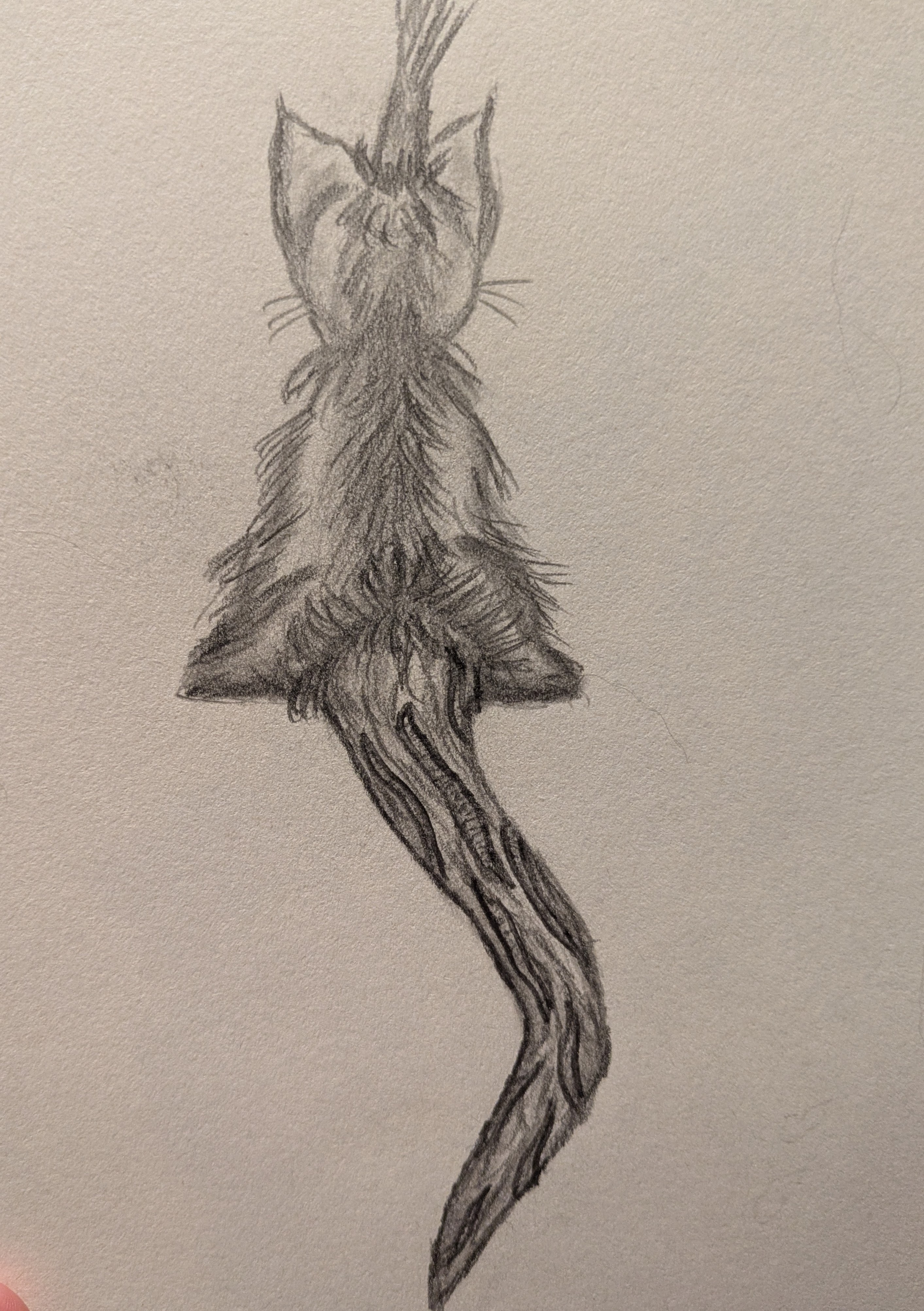
The results of this micro-lens study of the Black General were published. It confirmed that the Drid pollen is carried in the deep groves of the pollinator tail. Sketches were also made of two distinct types of tiny objects found in the tail grooves, believed to be the male and female Drid pollens, though there is no consensus on which is which. Drid naturalists provide no help in this debate; even confirming that pollinators use their tails to facilitate Drid reproduction is taboo. Again, their secrecy on the topic is not without merit. Ever since the Black General Study, Ramparossans have taken to capturing pollinators, chopping off their tails and releasing them back into the Border Forest as an insult.
As I am writing this volume, peace exists between Humankind and Dridkind all along the edge of the two Worlds. Because of this, it is easy for Human naturalists to see the Drid attitude of secrecy regarding pollinators as an annoyance. It must be remembered though that Dridkind have long lives and long memories, and violence between the two peoples is always a possibility. It is my hope that one day, all practitioners of the sciences can trust each other, and knowledge can be freely exchanged on all topics.
* Forests that value communications with Humankind sometimes include bipeds in this ‘complete Drid’ archetype, but it is not universal.
+ For this reason, some sources capitalize the nouns used for pollinators and host tree in the same way that Human, Drid, and Tower of Knowledge are capitalized to convey status. This volume does not follow that trend, so as to preserve the importance of the three peoples.
 Jayde Holmes