

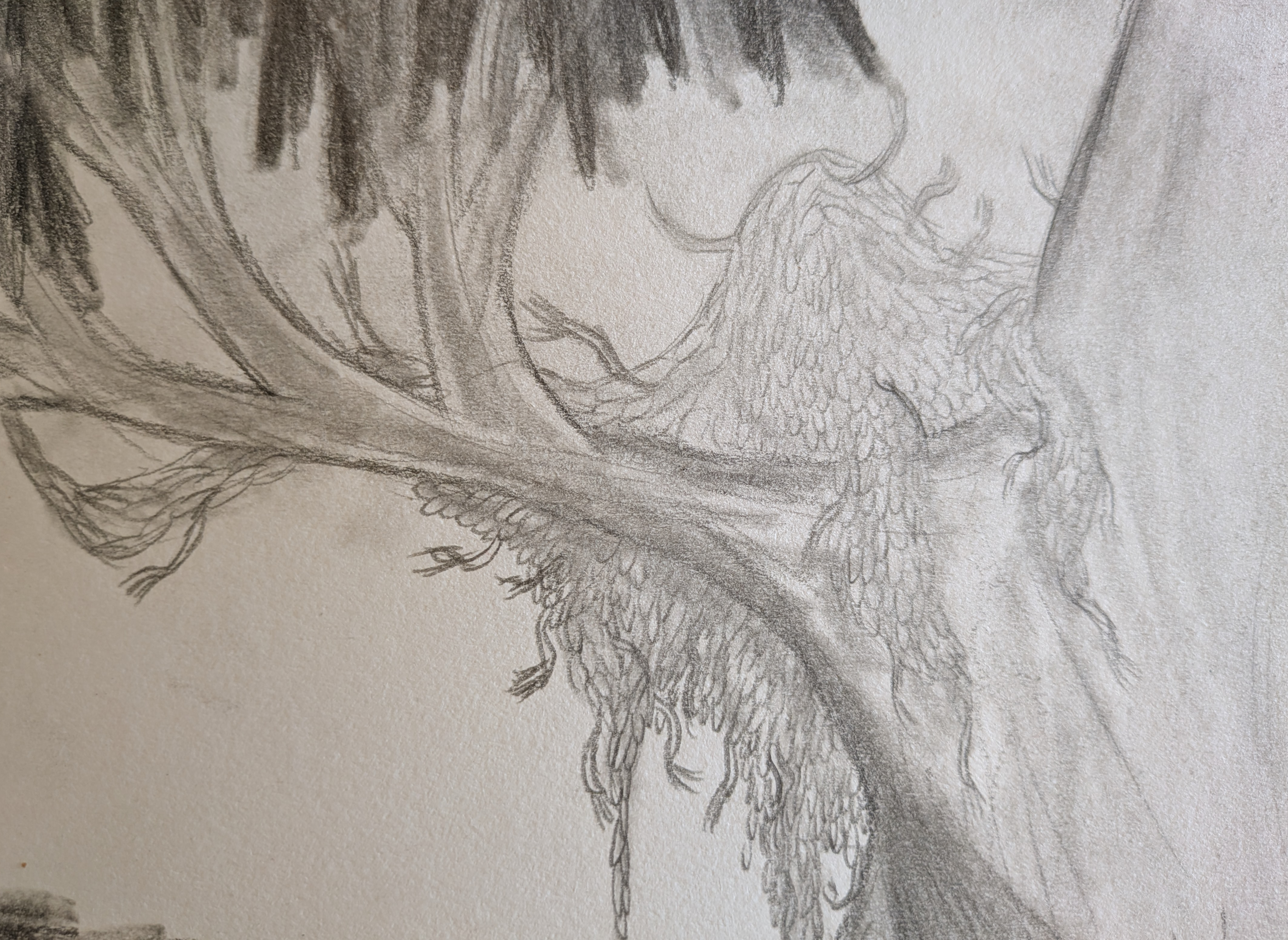
Name: Canopy Crawler
World: Black
Material: Mold/Flesh Hybrid
Thought Type: Untethered
Species Type: Farei
Habitat: Tropical Drid Rainforests
All creatures made of the mold/flesh hybrid material fascinate Human naturalists, since there is nothing like them in the Green World. Their body composition is as alien to Humankind as milk and live, fully formed births are to Dridkind. Of this massive order of creatures, the Farei* are of utmost interest to all naturalists, due to their resemblance to Dridkind.
Of the Farei, canopy crawlers are seen as the most similar to Dridkind. Like a Drid, a canopy crawler has a shapeless body littered with hooks, mouths, and telepathy tendrils. They have very little regular sensors besides touch and taste, instead perceiving the world around them by absorbing the perception of nearby creatures through their telepathy tendrils like a Drid does. Apparently Dridkind cannot passively absorb other perceptions anywhere near as easily though. Canopy crawlers can also possess small creatures and make them serve the crawler in the same manner as a Drid, though crawlers typically only use this ability to lure prey or deter predators. Despite having the ability to make prey come to them, canopy crawlers still prefer to ambush larger prey from dropping down from high branches.
Many naturalists, especially those who use the familial taxonomy, consider canopy crawlers a cousin species to Dridkind. They are viewed as what a Drid could be if they were able to choose the lifestyle of a singular mobile predator instead of being a hiveminded stationary parasite. Due to the harshness of a canopy crawler’s life, and their lack of intelligence and company, they are used in some Forests as a reason not to be envious of Human mobility. Alternatively, it is said that in dysfunctional Forests, canopy crawlers are seen as symbols of freedom, with a lifestyle to be envied and copied as much as possible.
No matter the opinion of the Forest they are in, their existence has shaped scientific thought. Their relation to Dridkind is used as confirmation of the familial taxonomy, with its implications of drastic speciation and inter-relatedness amongst different species. Likewise, the lack of such an alternative Human cousin is seen as confirmation that Green World life was created by a different process in the stars+.
There does not appear to be an upper limit to how large they grow, except that imposed by the difficulties involved in hunting food, avoiding predators, and traversing through the canopy in nature. Canopy crawlers kept secured by Drids and provided with unlimited food have been known to grow exceptionally large. The largest recorded specimen, raised as a joint research project between the Upper Stalax River Forest and the Keeper Forest of the Empty Forest, is reported to have had a circumference of 2.6 metres before its body began disintegrating. It is believed the disintegration was the result of difficulty reaching the wood within certain trees, which forms a small but apparently vital part of its diet.
At this point the Upper Stalax River Forest insisted on euthanatizing the test subject, despite the Keeper Forest wanting to see if the canopy crawler’s decline could be reversed. The naturalists of the Upper Stalax River Forest were convinced by the ward of the Forest’s Strongest to continue the experiment, using a treatment she had developed to ease the pain of the canopy crawler. The canopy crawler did not live for long, but the treatments attempted by the Keeper veterinarians and the Strongest’s ward led to breakthroughs in Drid medicine that aids the treatment of many common Drid ailments. Despite these breakthroughs, the involvement of the Strongest’s ward in perceived cruel Keeper experiments led to an attempted coup within the Upper Stalax River Forest.
Whilst wood seems to be a necessary component of the canopy crawler’s diet, it is only a small part of it. The crawler primarily eats meat, and despite the small size of its mouths, an adult crawler of sufficient size it can eat almost all parts of its prey if given enough time. Their muscles become so strong, that that they can crush bones and grind them up into edible morsels between their small blades. There are multiple stories of Human explorers in Drid Forests being found headless, with canopy crawlers nearby finishing off their skulls. Most of these stories however are thought to be merely local legends, or possibly exaggerations.
Despite the fear that these stories have given Humankind, canopy crawlers are one of the most common Black World creatures to be studied in Human lands. In the city of Lathi there is a small Black World Arboretum within the university gardens, and canopy crawlers are the only black world creatures that are constantly kept there. Provided meat and wood is shipped in regularly from the Black Forests, the crawlers can live long lives in the arboretum, though they remain rather small.
Canopy crawlers who have lived many years within the Green World do not always decay as normal upon death. Without the Black World environment, their skin does not always break down. This crawler leather has a variety of uses for Humankind, not only as a strong textile, but as an ingredient in an amazingly strong glue, and in deadly poisons. There is even demand within Drid Forests for this rare leather, as currently it is unknown exactly what is needed to make the crawler remains so durable. Though some experiments with immobile towers and other stationary mold/flesh hybrid creatures suggest that the leather can be made with other creatures too.
Canopy Crawlers have long been valued by the scientific community for the insight they provide on Black World life. As we learn more about the capabilities of their body though, they are becoming more valued by laypeople as well.
*Drid Forests vary on their beliefs about this family of creatures so greatly, that they are one of the few groups of Black World animals where the descriptors provided by Drids are so inconsistent that naturalists use a Human word to describe them.
+ Whilst some argue that bipeds are a cousin species to Humans, there are a variety of reasons this is not possible. See the entry on bipeds for more information.
 Jayde Holmes