

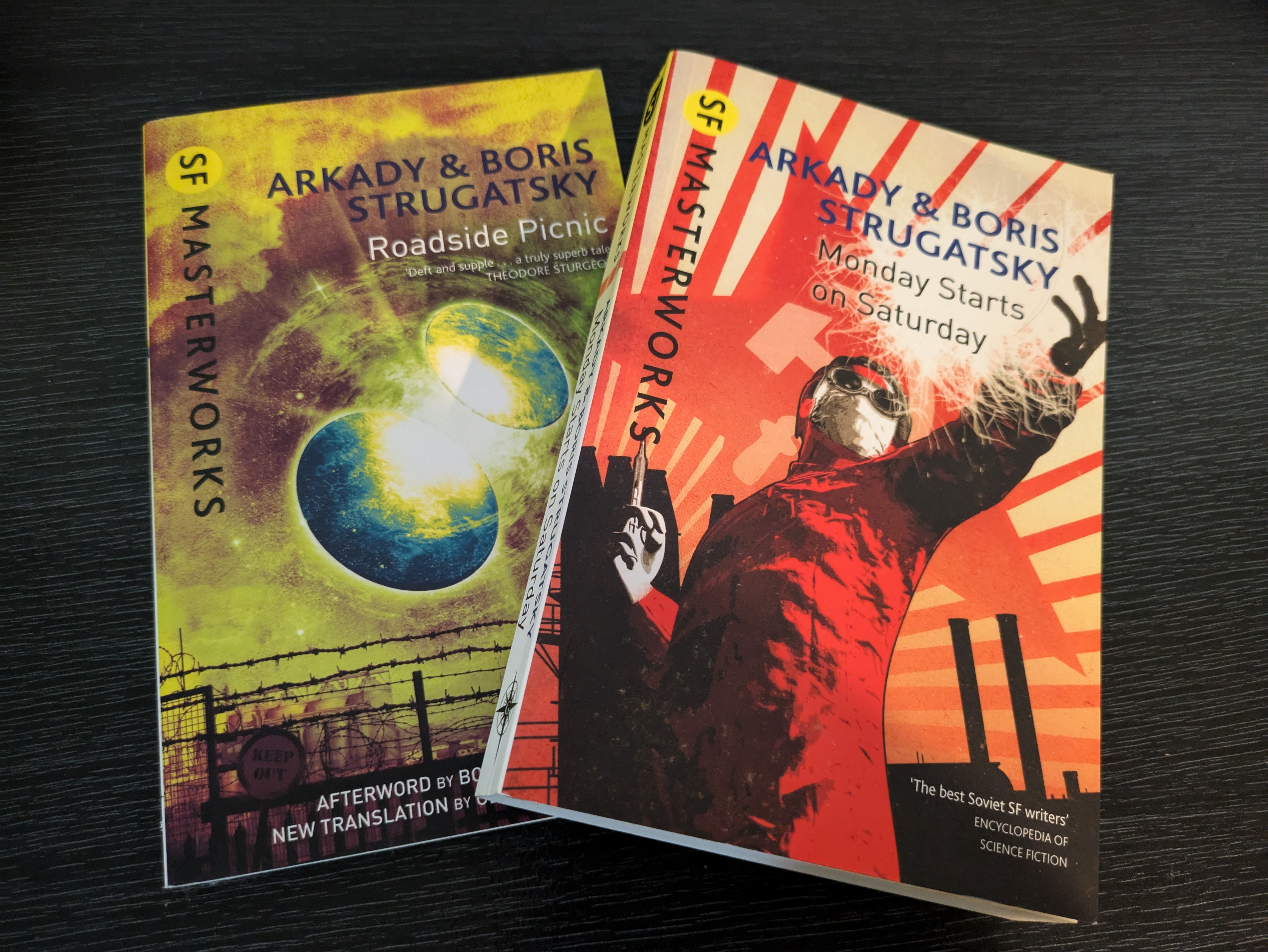
I like talking about older Science Fiction, but I haven’t had a chance to do so in a while. So let’s talk about Arkady and Boris Strugatsky, Soviet/Russian brothers who wrote dozens of science fiction stories together. They were – according to the Encyclopedia of Science Fiction quote on my copy of Monday Starts on Saturday – the best Soviet SF writers. They are the only Soviet SF writers I have read, and even the only Russian writers I’ve read, so it’s impossible for me to verify this claim. I can however talk about the two Strugatsky books I’ve read over the past year; Roadside Picnic and Monday Starts on Saturday.
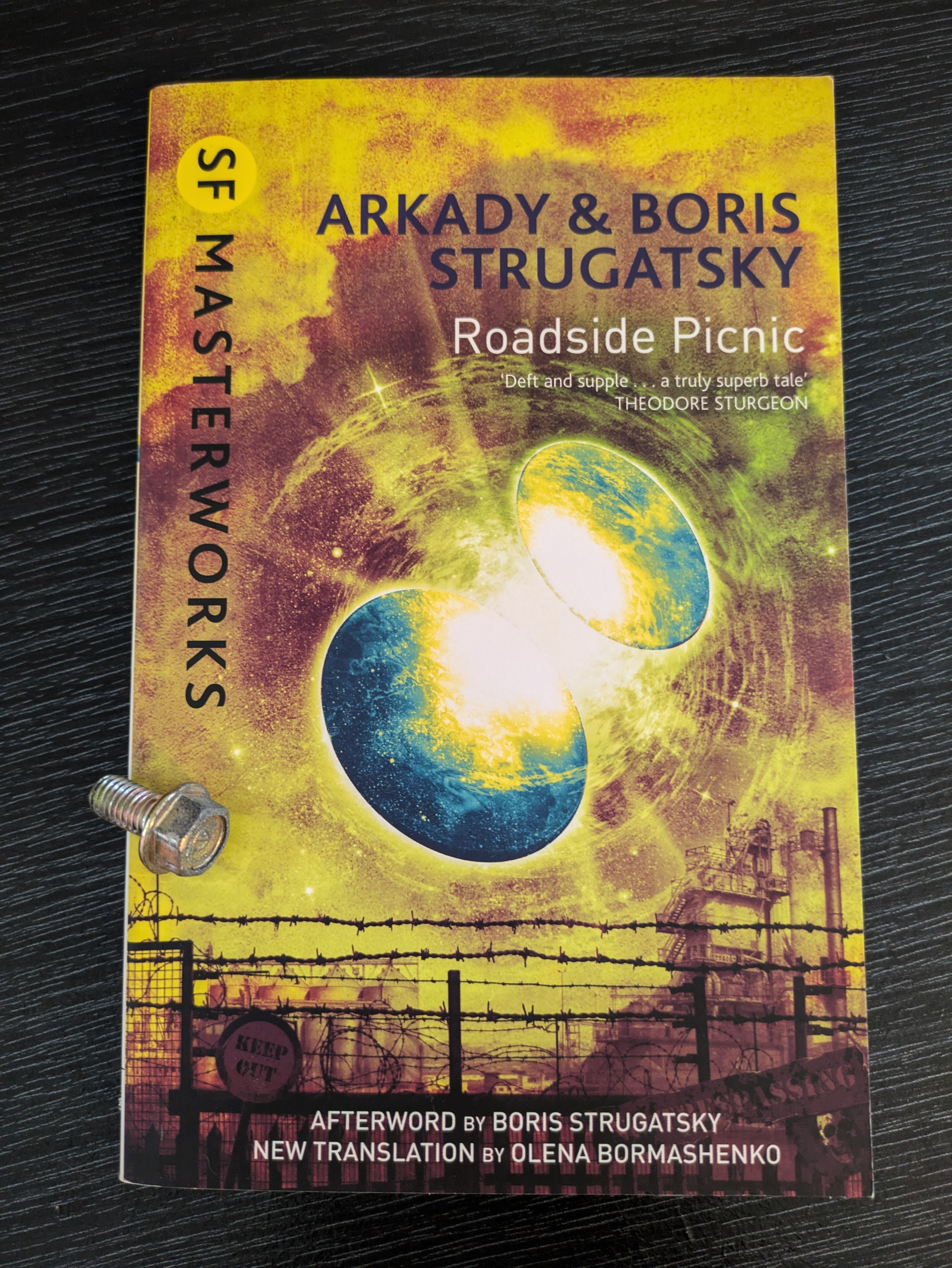
ROADSIDE PICNIC
Roadside Picnic is their best known work, so lets start there. It was adapted into the movie Stalker by Andrei Tarkovsky and a video game of the same name. I haven’t played the game, but my husband was interested in this book due to it, so I ended up reading the first chapter to him aloud one night. Probably not the best bedtime story, considering how tense that first chapter is, but he was fine.
This story has a really interesting take on first contact with aliens. Instead of any meaningful interaction taking place between the aliens and humankind, the aliens land on multiple spots on Earth, leave without seeming to notice humanity, and leave behind technology and strange effects in the nearby areas that we just cannot understand. The comparison with a family of humans stopping somewhere for a roadside picnic and then leaving their rubbish behind to alter the environment of the ants is made. This view of aliens being so far advanced that we cannot understand them and we are insignificant to them isn’t unique, but I think Roadside Picnic is one of the best examples of this approach in part because it doesn’t try to let us see the aliens, it just shows the aftermath of their presence and its effect on regular humans.
After this alien contact, an event called The Visitation, governments near the affected zones seek to extract and study alien devices. However, going into these zones is extremely dangerous. Despite the danger, there is a subculture of scavengers (called Stalkers) that illegally sneak into the Zones to steal these artifacts and sell them on the black market. Our protagonist, Redrick Schuhart, is one such stalker who in the beginning is looking to go legit. He is working for a government institution that is gathering the materials for scientific purposes. The opening chapter has Red leading a three man team into the Zone on a government backed extraction mission, with state-of-the-art equipment. Even with this equipment and support, it is still so dangerous. The Strugatsky’s do a great job of building this tense, unsettling scene where even though things look fine, we know that death could come from anywhere and we might not even understand what’s going on. I got similar vibes to when I watched Annihilation. I have not looked into it, but I wouldn’t be surprised if Jeff VanderMeer took some inspiration from Roadside Picnic. (edit: okay, I read the Wikipedia on Annihilation. VanderMeer says that Stalker/Roadside Picnic were not influential in Annihilation, but I am not the first one to make the comparison.)
Whilst Red is making this trip into the Zone, he is also on the lookout for a rare device for his black market contacts. Despite wanting to go legit, Red still has his price. After the expedition, one of his friends from the institute ends up dead, his deal with the black market is exposed, and he finds out his girlfriend is pregnant. After that, we have a time skip, and through Red we examine what could drive someone to continuously risk their lives and freedom in a place like the Zone, or to contribute to a project that they know is probably linked to developing deadly weapons.
Slight spoiler… the answer is desperation. Desperate people will do anything to try and provide for their families. It’s that simple, and this book does an excellent job of showing that. Though, not just desperation. There is this longing for the Zone and its mysteries that pulls people in too. I did feel the story dragged a bit in the middle. Not sure if its the story itself or the translation, but following an investigation on the stalkers from a distance wasn’t as interesting as going into the Zone, though, it’s obviously still important to the plot, and I don’t think Red’s last trip into the Zone, where he’s looking for a reality-warping device said to be able to grant any wish, has the same sort of impact without seeing how harsh life is outside the Zone too.
Whilst its been a while since I read this book, I watched the movie recently and was quite captivated by it. It was very different from the book, being entirely focused on a trip into the Zone, and focusing on the object at the end of the book that is said to grant wishes, but instead making it a mysterious room that granted desires. My attention span has been shot lately, so the slow pace was hard for me to get into at first, but by the end of it my eyes were glued to the screen.
Speaking of the movie Stalker, the story behind the production was quite extreme, and may have resulted in the deaths of at least three people, including the director. CinemaTyler did a good video about it HERE. I probably shouldn’t link directly to the movie here, but the full movie is available with English subtitles on Youtube.
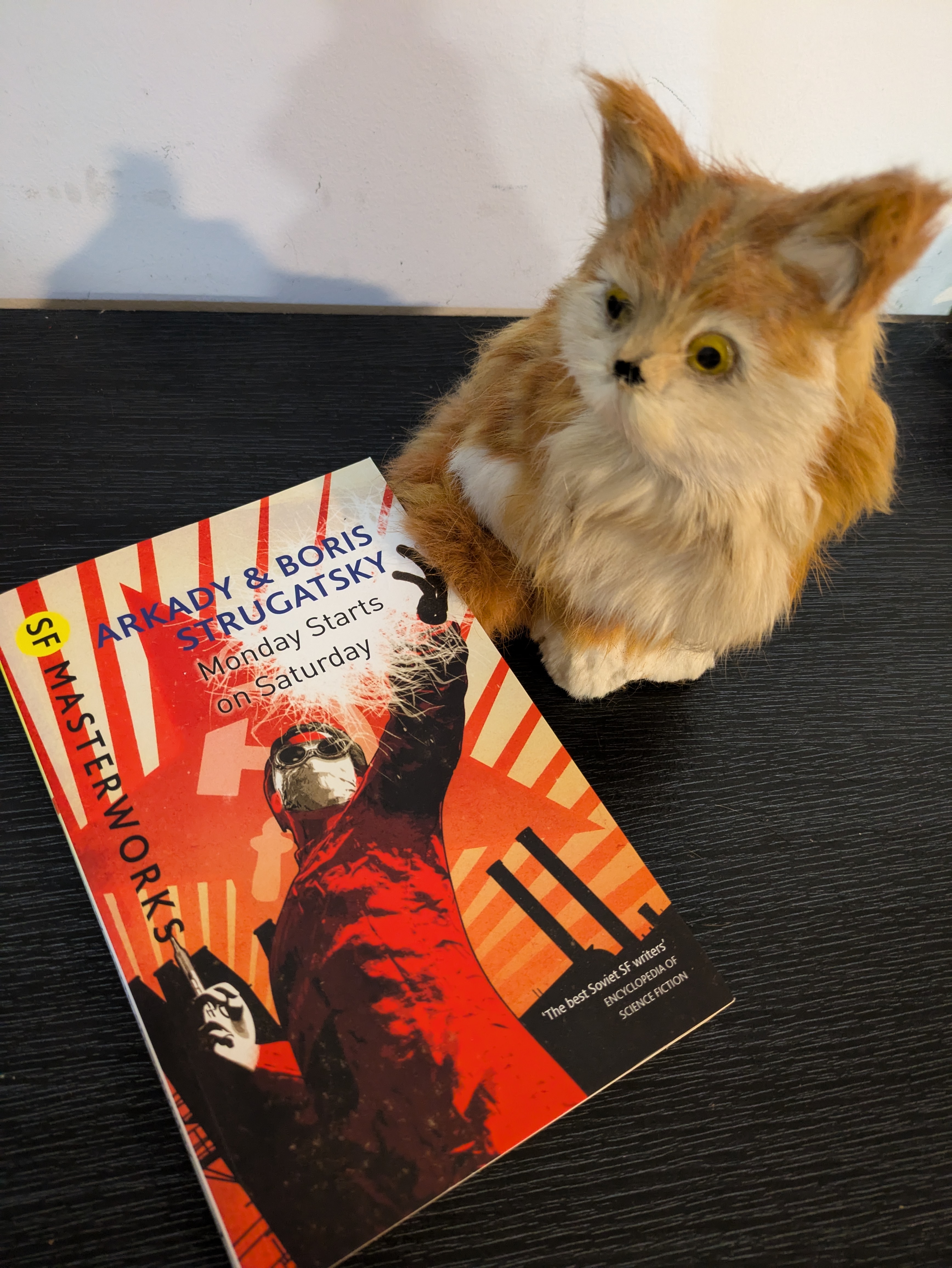
MONDAY STARTS ON SATURDAY
I’ve just finished reading this book. It is not as well known as Roadside Picnic, which is a shame because this story is absolutely bonkers fun. The premise is that this computer programmer, Sasha, (and this is set in the 60s, so computers are different) is heading up to a remote part of Northern Russia to go camping with some friends. He picks up a couple of hitchhikers, and it turns out they work for a research institute that studies magic, and they could really use a computer programmer, so they try to recruit him. They provide him lodging in a museum associated with the institute… which is kinda a house on chicken legs run by a witch, and he sleeps on this magic divan (I think some translations call it a sofa) that translates normal reality into fairytale reality, so things get crazy for Sasha really fast.
Despite all this, Sasha takes everything in stride. He quickly gets over his freak out at all the talking animals and weird stuff, and quickly gets curious about all the phenomena he encounters. He gets super excited when he gets a coin that returns to him after being spent. He goes around town buying small things with the coin, giving it to shopkeepers in weird ways to try and work out when it returns to him (He says placing it on his elbow and having the shopkeeper take it that way still works… any retail workers ever seen someone try this?) and he goes around doing this very obviously until the local militia comes to question him about it. He doesn’t get into much trouble though. At many times, Sasha seems pretty over all the crazy magic stuff that happens in this town, but in the end, he just can’t turn down the chance to study magic.
This book is divided into three separate stories. The first, The Commotion over the Divan, is all about Sasha arriving in Solovets, sleeping on the magical divan, and discovering all the magical shenanigans in this town. The second, Vanity of Vanities, jumps forward to Sasha working at the Institute as a programmer (one of the ‘precise sciences’) and he’s drawn watch on New Years Eve. Due to labour regulations, everyone not essential is supposed to have the day off, so Sasha has strict instructions not to let a single living soul into the Institute (and no dead souls out). Unfortunately, the institute is full of workaholics whose motto is “Monday starts on Saturday” and who all have more magical ability than Sasha, so, that doesn’t go too well. One of the other scientists is running a particularly dangerous and disturbing experiment during this time, which leads to some interesting musings on consumerism and the public’s relationship with science. The third story is called All Kinds of Commotion, and follows Sasha getting into a fair few time-travel and multiverse travel related mishaps while he’s waiting for his recently blown-up computer to be fixed. As well as trying to work on the workplace newspaper. As this stuff happens, he and his friends find a dead parrot that starts to unravel the mystery behind the Institute Director, and that little puzzle and reveal was so cool.
I enjoyed this book so much. Even though at times I felt the satire flying over my head, and I’m not familiar with all the Russian fairytales being referenced. At the end of this book I still wanted more, and discovered there is a sequel novella with two more stories, called Tale of the Troika. It seems a bit harder to find, but I think I’m going to have to dig it up and edit in or do a new post for it later, because I want more of this insane ride.
My copy of Monday Starts on Saturday starts with an introduction by Adam Roberts where he talks about comparisons between this story and Harry Potter. I generally try to avoid talking about that franchise and its author, but in case readers have encountered this comparison I just want to say that no, it is not accurate. This is not Soviet Hogwarts. Both stories have a character new to magic getting thrown into a place full of it, with a lot of folklore references, and that is the only similarity. I thought it was bad when everything with a magic school got compared to Harry Potter, but this is a real stretch. We need to stop using Harry Potter as the point against which all hidden magical worlds are compared against. It wasn’t good before Rowling went full TERF, and it certainly isn’t good now. Though, if anyone knows any good fanfics where Hogwarts is a Soviet research institute, please share.
In conclusion, I enjoyed both these books and would happily keep picking up more Strugatsky SF Masterworks paperbacks. I definitely picked two books that were wildly different in tone, subject matter and renown, so it’ll be interesting getting a third data point. There were a few things both books had in common that I wasn’t a fan of. They both had slower, clunky parts, which could be the time they were written in, the translation, the writing style or a bit of all three. There were also big info dumps at times and philosophical musings. Not enough to make me not enjoy the books, but they were there and noticeable.
So, I wanted to conclude this review with an ‘In Sovient Russia, X verb You” meme, but I couldn’t really think of one, and I don’t think anyone even remembers that meme anyway. So I’ll just sign off wishing everyone the best.
~ Jayde
 Jayde Holmes
Excellent comment!!! “The tale of the Troika”, the sequel to Monday is very different. Harsh satire against the soviet admin and judicial system. Even more funny, more weird. Two versions extist of this book. “T.o.t.T. 1” and “T.o.t.T. 2”.
The 1 is the integral book as written originally by the authors (it’s been scarsely translated… the most relevant recent is the italian translation, 2023, rich of footnotes… “La favola della Trojka”). Troika 2 has been translated in english during the seventies, coupled with Picnic. It’s edited by a half, some characters are missing. The story is settled at the 76th floor of NITWITT, while in the original integral version is settled in the fantastic city of Kitezgrad (the invisibile city of the russian folklore).
Thanks :D. Sometimes it’s so hard keeping track keeping track of translations, but it sounds like the first translation of T.o.t.T. 1 turned it into a different story almost. Was it all the translation or did Soviet censorship play a part in the two versions?
T.o.t.T.2 sounds really cool. I’d never heard of Kitezgard before, but that legend sounds so interesting. Like an Atlantis but in a lake with divine protection..
Pingback: 2025 Book Bingo Reviews #2 – Jayde Holmes
Pingback: 2025 Book Bingo Wrap Up – Jayde Holmes