
The ballots of the three major SFF awards have been out for a while now, so it’s time for one of my favourite yearly traditions: reading all the short stories that have been nominated for a Hugo, Nebula or Locus. Well, I say all, but I’m a bit cash strapped at the moment, so I haven’t been able to go too far out of my way for stories that are not free online. his year Woolly by Carrie Vaughn and Secret Night by Nathan Ballingrud weren’t easily accessible for me, so I won’t be reviewing them.
Both Wooly and Secret Night were only nominated for the Locus award. Six out of the ten Locus nominees were not on the Hugo or Nebula ballots, up from four last year. The overall amount of unique ballot entries this year also increased from seven to nine. This isn’t too big a divergence. In 2024 there were 13 stories that were only nominated for one award. One thing that jumped out to me though was that this year there is only one short story that made it onto all three ballots; In My Country by Thomas Ha, as opposed to three stories last year.
That’s enough statistics. Let’s get to some reviews.
Hugo + Nebula + Locus
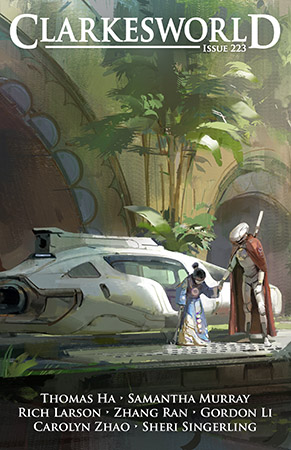
In My Country
By Thomas Ha
Published Clarkesworld 4/25
This year, only one short story has been nominated for all three awards and damn, it is a good one. In My Country is a story told by a father in an authoritarian country with pervasive surveillance and government officials in blue houses in every town. But our narrator is not a resistance fighter, he’s just a man raising his kids alone. As the kids grow up though, they start to have their own thoughts about the country, and take what risks they can.
The son is a writer, whose stories become quite popular, despite not having clear meanings. This is dangerous, because whilst is is legal to criticize the First Citizen and the bureaucracy, you must be very clear what you say. Saying anything ambiguous, which could cause people to actually think on the subject, is a different matter.
It’s an interesting discussion about the power of stories and interpretations in such controlling regimes, and the way its told was super unsettling. The descriptions of the wind and the static being felt behind the picture frames and mirrors as the family discuss sensitive topics at dinner, and any time the Blue House Man was described were really chilling.
This is a hard-hitting, thought-provoking story that will stay with you for a long time.
Hugo + Locus
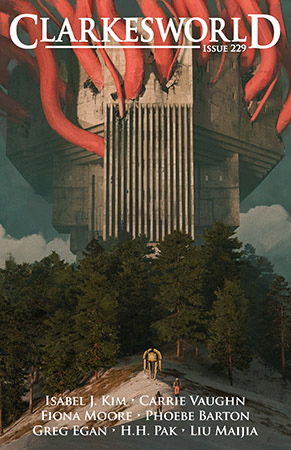
Wire Mother
By Isabel J. Kim
Published Clarkesworld 10/25
Here’s a familiar name. I read Isabel J. Kim’s short story Why Don’t We Just Kill the Kid In the Omelas Hole last year and despite that story winning both the Locus and the Nebula award, it didn’t really land with me. I gave me the same vibe as someone trying to wriggle out of a trolly problem scenario, and I couldn’t shake that feeling enough to fully engage with the points Kim was making.
I liked Wire Mother a lot better. It’s a story about a young woman whose mother is a digital person, and she has a lot of emotional issues because of that. I’d be very surprised if Kim wasn’t drawing on Harry Harlow’s Monkey Experiments whilst writing this. In one of Harlow’s experiments, he separated infant monkeys from their mothers, and put them in enclosures with two surrogate mothers, one made of cloth, and one made of wire. To his surprise, he found that the infants bonded with the cloth mother, even if the wire mother was the only one that provided food. This proved that infants have a need for physical ‘tactile comfort’ and that this is just as essential to development as meeting obvious physical needs like food. Kim doesn’t reference Harlow’s experiments in the story, besides in the title, but she still explores the dangers of lack of attachment that can result from being raised by a digital/AI person, something I don’t think I’ve seen discussed in SF very often.
I’ve been thinking for a while that the rise of LLMs is going to change the way science fiction stories handle robots and artificial intelligence. Before, robots could be a stand-in for humans that have been othered, but now that we hear the term ‘AI’ and think of a lying thieving bot with very little use, those types of stories, where we sympathize with the AI, aren’t going to hit the same way. I really like that in this story, Kim has created digital people, who are distinguished from deepfakes or our understanding of ‘AI’ (though, I think the story still leaves some ambiguity about whether they are people, and I like that) and presents us with a realistic depiction of some of the issues that may arise from the clash between human behavioral needs and the limitations of an artificial person.
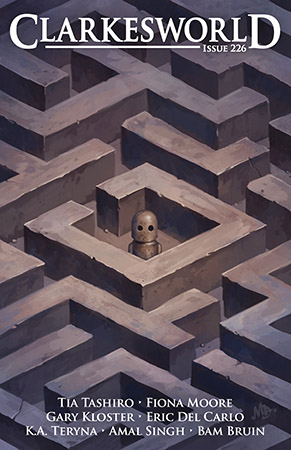
Missing Helen
By Tia Tashiro
Published Clarkesworld 7/25
Third Clarkesworld story on both the Locus and Hugo ballot, been quite a good run. This is my least favourite of the three, but it is still a good, thought-provoking story. It opens up with a woman finding out her ex-husband is marrying a a much younger clone of herself, which if I’m being completely honest, is exactly the kind of drama I scroll Reddit for. But this is a very serious story, and the set up is used for two characters to reflect on their lives, both their nature and their upbringing, and think about how things could have gone differently.
One thing that put me off this story initially was that it started out in second person. I’m not totally against that, but it has to be for a good reason to make me happy. In the end I was satisfied with why it was in second person. One thing that didn’t click for me was the Helen of Troy references, but they didn’t hurt the story. Overall this was a solid, emotional piece that reflects well on the old nature vs nurture question.
But also fuck Mark. Dating a much younger clone of your ex-wife is messed up. YTA Mark.
Hugo + Nebula
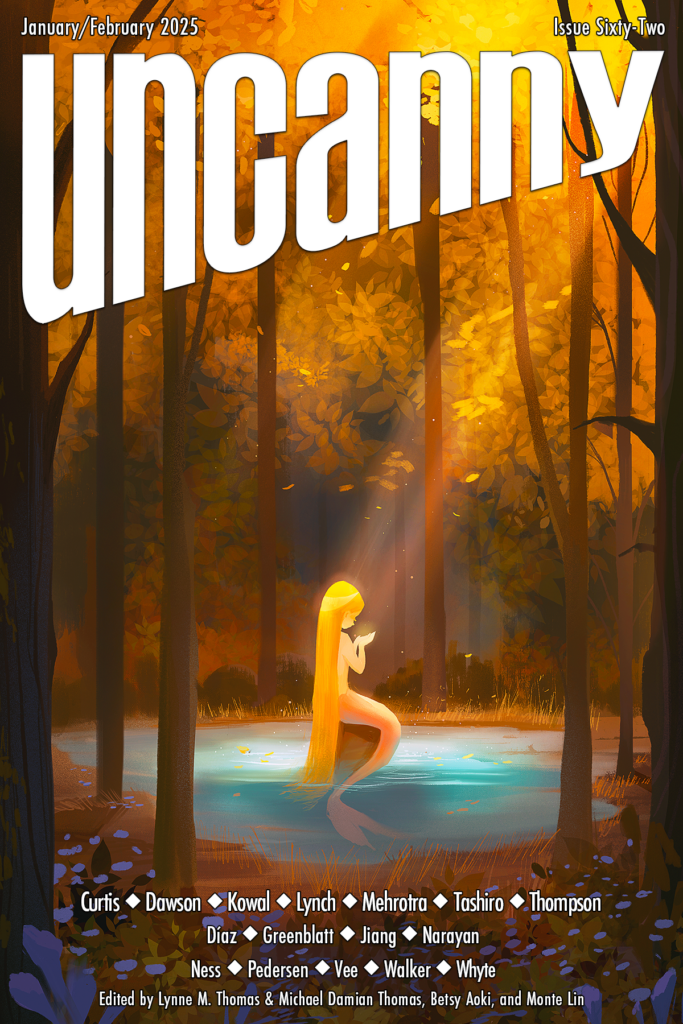
Six People to Revise You
By J.R Dawson
Published Uncanny 1-2 25
This is a short, impactful story about Liz, a non-binary teacher in a future that has continued to get shittier, preparing to get revised. Its a bit vague what revision means, but it seems to be a surgical procedure that can change anything about your appearance or personality. To determine what gets changed, you need six people with different relationships to you to fill out forms listing what they think should be changed about you.
It’s a concept that gets more disturbing the more I think about it.
Dawson takes this dark, dystopian idea and uses it to tell a powerful story about self-acceptance and the power of positive words from people who actually love and accept us. And about the dangers of putting too much importance in the negative things people say to us.
Even though the story is really short, we get to connect with Liz very quickly, and I felt the blows they felt when people wrote down things they thought they should change. Uncanny hasn’t dominated the ballots as much as it has in past years, but this story shows that they are still very good at publishing stories that make you feel.
Laser Eyes Aren’t Everything
By Effie Seiberg
Published Diabolical Plots 5/25
This was great. Not subtle at all, but it doesn’t need to be, and actually really shouldn’t be. There is nothing wrong with a story having a very clear message, as long as you have a good story to tell, which Seiberg has. It’s about how stupid it is that accessibility isn’t taken seriously. It’s about a woman with super-powers, who is still a wheelchair-user, and the super-hero league won’t even put a ramp in their building so she can attend meetings.
This is a story that really makes you feel the frustration that comes with not being able to do stuff just because other people are too petty to make small accessibility concessions. It’s also a story that challenges the basic ideas of a superhero story. The superheroes here are adamant that their job is to fight and stop supervillains, and reject proposals to do things like install roundabouts. But, in real life, if city infrastructure was killing or putting civilians at risk, wouldn’t they want to change it? I’ve seen a few big superhero stories where the villain is clearly right, but then they just do something unnecessarily evil so that the hero, despite being sympathetic to their cause, has a reason to stop them. There usually isn’t any other detailed alternative solution provided, but the villain did evil stuff and nothing has changed, so it’s all good.
I am very pleased to say that Laser Eyes does not fall into this pattern, and that alone makes the story feel fresh.
Nebula + Locus
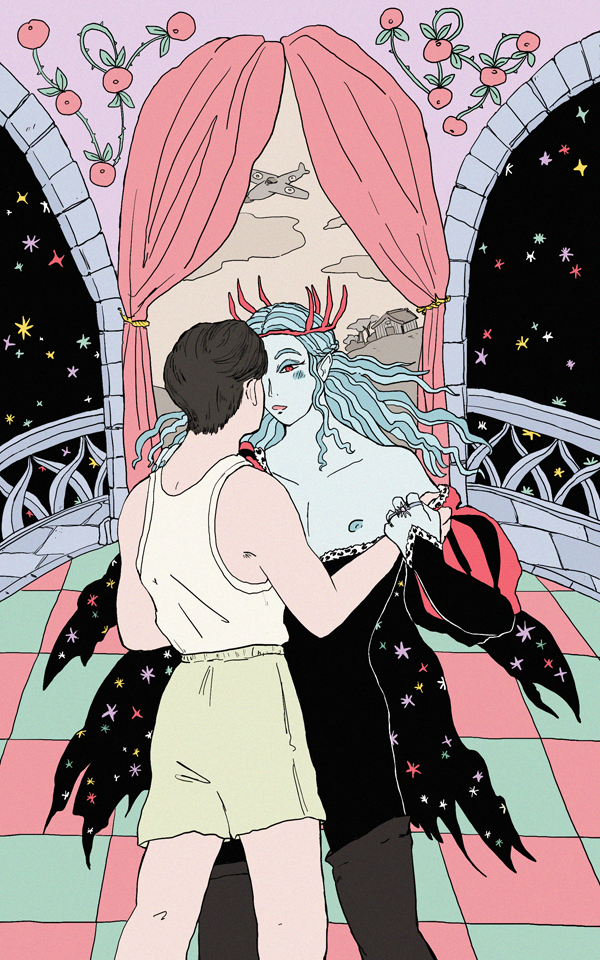
Because I Held His Name a Like Key
By Aimee Ogden
Published Strange Horizons 16/6/25
Okay, where to start with this one. Usually coming across a story I don’t like is interesting, because analyzing the things I don’t like about it gives me a lot to say, but here it’s like, I’m not quite sure why I dislike it so much. I think part of the issue is that Ogden’s writing style isn’t to my taste. I like things fairly straightforward, but a lot of her prose feels more like poetry, and I’ve read a lot of other stories by her that I just haven’t been able to get into. (Though I don’t hate everything I read from her. I recently read her flash story A Simulacrum of Self in Small Wonders and enjoyed.)
Despite that, this story does still have a lot of interesting ideas. I’s about Alan Turing’s visits to a faery realm, where he becomes a lover of the Autumn King. Turing tries to understand the physics behind this magical place, whilst the Autumn Lord tries to convince him to stay of his own free will, even though he can just compel him to stay using the power of his true name. There are a lot of interesting discussions about free will and consciousness, and even a fae retelling of the Chinese Room thought experiment.
So, this one didn’t land for me, but I can see how it got on two different ballots.
Nebula
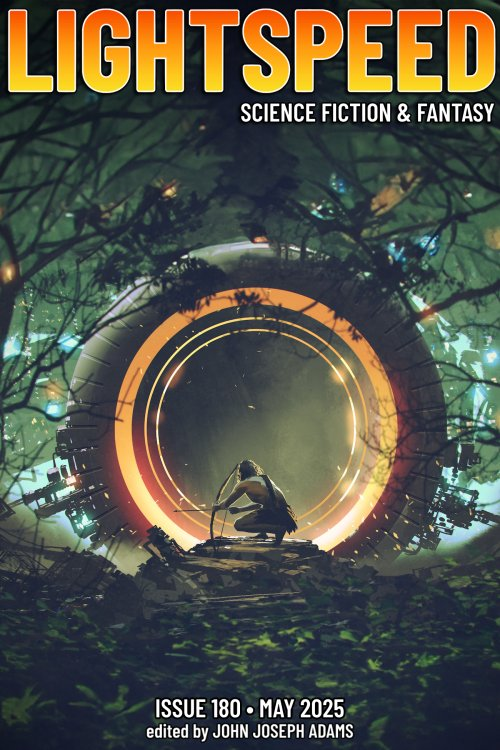
Through the Machine
By P.A Cornell
Published Lightspeed 5/25
Well, this feels way too real. It’s about an actor, who has gone through all the shit Hollywood puts actors through to turn them into a product, only to become a literal product after agreeing to let studio’s scan his body and use his likeness in AI generated movies.
As I said, this is getting way too real. Cornell does a great job exploring the implications of increased AI usage on the movie industry. Besides seeing our A-list actor replaced, we also see the effect on supporting positions like stuntpersons, and the knock-on impact the AI replacement has on Broadway.
What makes this story extremely good at delivering it’s anti-AI message, is that it doesn’t just call out the studios who replace humans to save money. Our A-List actor browses fan accounts, and sees fans using AI generated images of him for shipping or just because they prefer him looking a certain way. Sometimes, these fan AI-generated images make the actor really uncomfortable. Everyday people using AI legitimizes it’s use, and that is dangerous. I’m glad it gets called out here.
The Tawlish Island Songbook of the Dead
By E.M. Linden
Published PodCastle 2/18/2025
This is a really beautiful story showing the effects of migration on the people of a small island. It stars with the last 37 residents leaving the island as the ghosts of their relatives watch on. The ghost of little Katie Zell’s father watches as his family evacuates, his wife taking the children and the songbook with the Island’s traditional songs. Most of which are magic spells that can only work on the island. Nearby Maureen Stornaway looks back and sees the ghost of three of her children, who’d died as infants.
The dead have no way of knowing what happens to their descendants after they leave the island. They send dreams to the living and and wait for them to return. As the years go by though, they begin to fade, wondering if the living still remember them.
It is a devastating story, but also a beautiful one. The PodCastle team did an excellent job telling it in an audible format too. I highly recommend this one.
Hugo
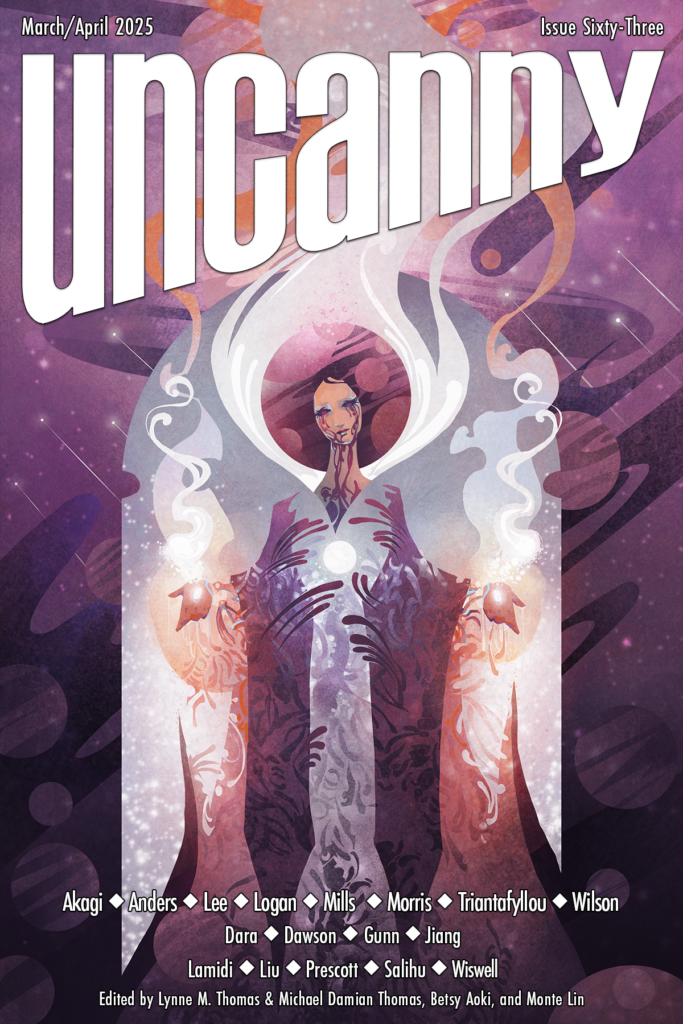
10 Visions of the Future; or, Self-Care for the End of Days
By Samantha Mills
Published Uncanny 3-4/25
This is a really short piece about a couple doing the best they can to survive after a bunch of Lovecraft-style cultists open a hellgate. They also get a witches’s crystal ball which lets them see other potential futures, with different disasters that could have hit them. With this set-up, Mills is able to present us with a ton of different disasters, some supernatural (eldritch monsters, zombies) and some mundane (floods and fires. Even if its hellfires) in a very short wordcount. As the title of this story implies, the most effective methods of staying sane and alive aren’t always the most obvious. Hobbies and human connection are celebrated here.
I also want to point out that whilst the disasters described are caused by cultists and a hellgate, there are a lot of things happening that feel very real. I have to admit I was a bit skeptical about the concept of this story after just reading the title, but I should have trusted Samantha Mills to deliver. After all, in 2023 she won all three awards with her amazing and very topical Rabbit Test. It’s hard for any story to compete with Rabbit Test, but Self-Care doesn’t feel like a step down and that’s saying something.
Locus
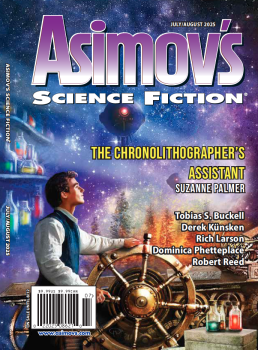
In the Halls of the Makeshift King
By Tobias S. Buckell
Published Asimov’s 7-8/25
Okay, this is another one that I just wasn’t that keen on, but I did really like the ideas behind it. It’s about pilgrims at as massive cavern who first move around a great hall tracing the movement of massive gears beneath the hall. If they persist with this they become spinfolk; the people who push the handles that turn all the gears. The mechanism is all to move a massive door, butt tthe whole thing is so ancient that no-one knows what happens when the door makes a rotation and opens, or even why they are still doing this.
Despite not knowing the purpose behind this massive door and mechanism, people still come and push. hey come for a variety of reasons, seeking different things, and have different ideas about what might be beyond the door. This story is able to examine the purpose of traditions very well in a very short amount of time. Whilst I’m frustrated with all the worldbuilding stuff that was left unresolved, I do appreciate that those unknowable elements are important. What can any of us do when we don’t know what we’re working towards? And is striving with no guarantee of reward or answers worth it?
I think the more I think about this story, and some of the ideas Buckall presents us with about humanity, the more I will like it. My main issue was that it is a very complex set-up for such a short story, and by the time I got my head around the setting and main character, the story was already winding down.
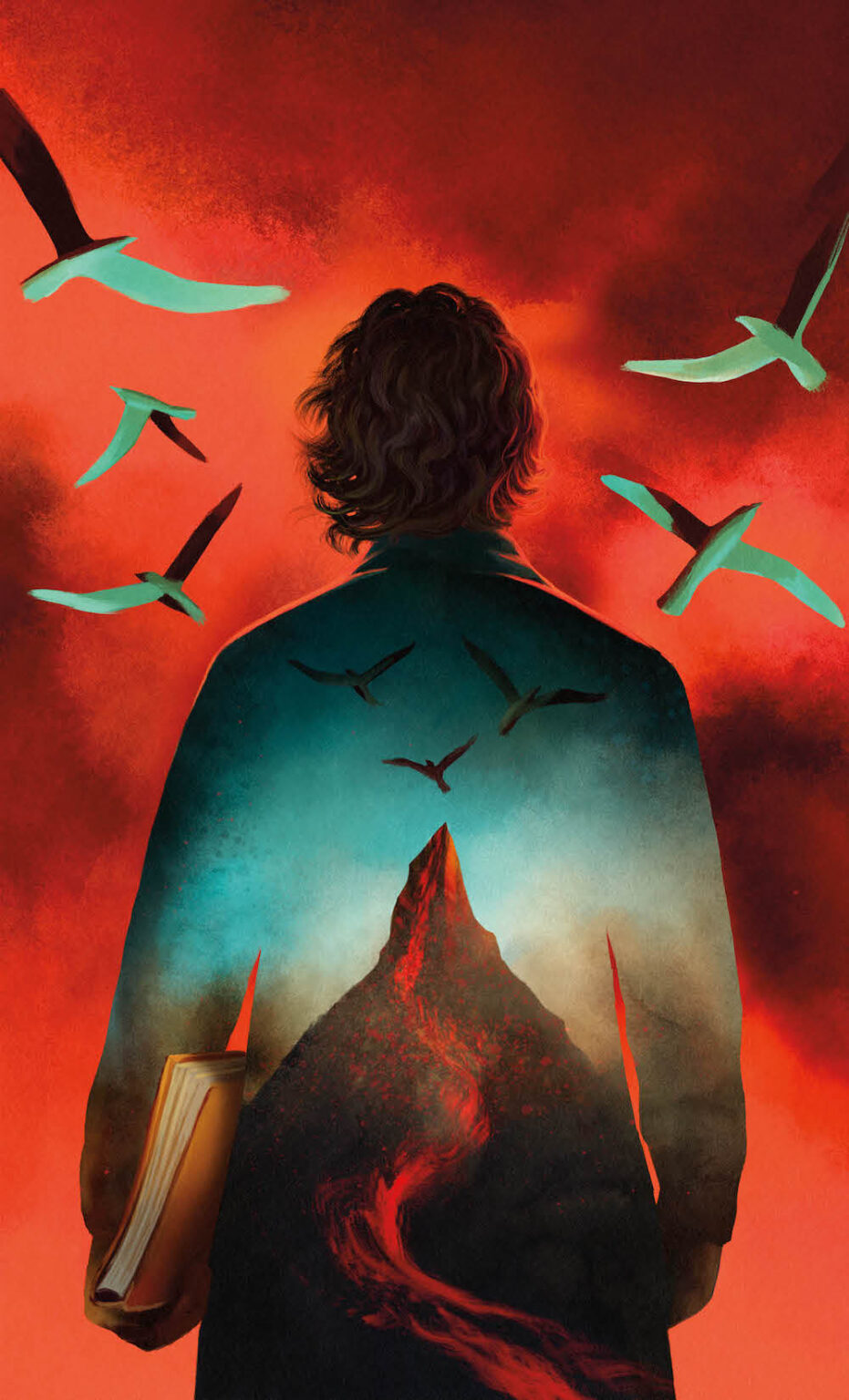
The Shape of Stones
By Hildur Knútsdóttir
Published Reactor 3/12/25
This is a nice little horror short, with a lot of nods towards Icelandic history. I was excited about this one, because I’d previously read Knútsdóttir’s novella The Night Guest translated by Mary Robinette Kowal and really liked it. This story doesn’t have a translator credited, so I assume Knútsdóttir wrote it in English, which I find impressive.
The story is about an Icelandic researcher investigating stones that he suspects are related to ancient stories about human sacrifice. It is told through his research notes, and we learn a lot in just these little notes.
I do have mixed feelings about this one, because it had an ending that at first made me go ‘oh, that’s it?’, but the more I think about it, the more I realise it has implications beyond the obvious one. I think the story might have been better if Knútsdóttir had a bit more time to cook, but there was a detail at the end that might have added more oomph if I knew more Norse mythology, so maybe it was actually the right length.
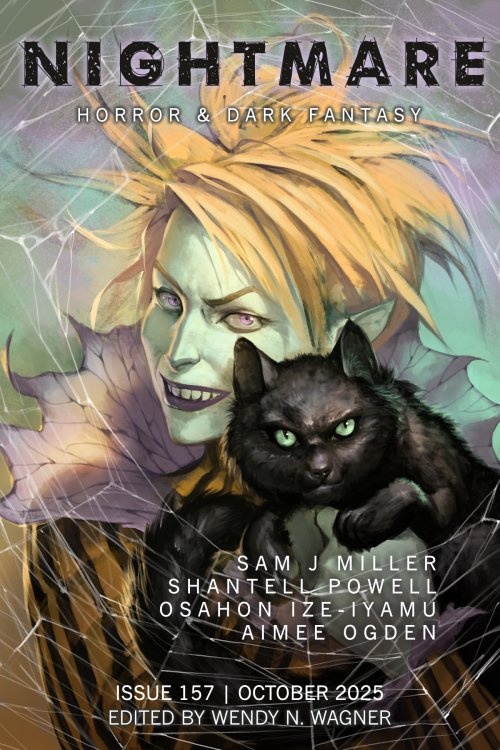
Courtney Lovecraft’s Book of the Dead
By Sam J. Miller
Published Nightmare 10/25
I am actually wondering if this is a mistake, because the wordcount listed for this story is 7,705 words according to Nightmare, which puts it into the novelette category. If that count is accurate, it is actually longer than John Wiswel’s Phantom View, which is a Locus nominee in the novelette category. To investigate, I counted each word individually. Nah just kidding, I copied the whole text into Word. Word only counted 6719 words to this story, which puts Courtney Lovecraft in the short story category. Since Locus put this story in this category, I’m going to assume Nightmare made the mistake with the wordcount, and it is a legitimate short story.
Okay, time to stop splitting hairs about the wordcount and talk about the actual story, because this may be my favourite story out of this year’s finalists.
But it is hard to talk about, because getting hit by the revelations of this story is really powerful. I’m not going o say twists, because I think you can figure out where it’s going before the ‘wham line’… but the wham line sill hits regardless. Plus just figuring out what is going on at first is cool. Though to ease any confusion, the story is in the form of a transcript of a podcast episode. The fictional podcast we are ‘listening’ to (which you can very easily listen to, Nighmare has a podcast, and this story does get narrated.) is a paranormal investigation show, and this episode is about a drag queen medium called Courtney Lovecraft. Our host, Evan, quickly realises as he interviews Courtney that he’s in for some really spooky shit, as well as Courtney’s snappy attitude.
Landline
By Kelly Robson
Reactor 3/5/25
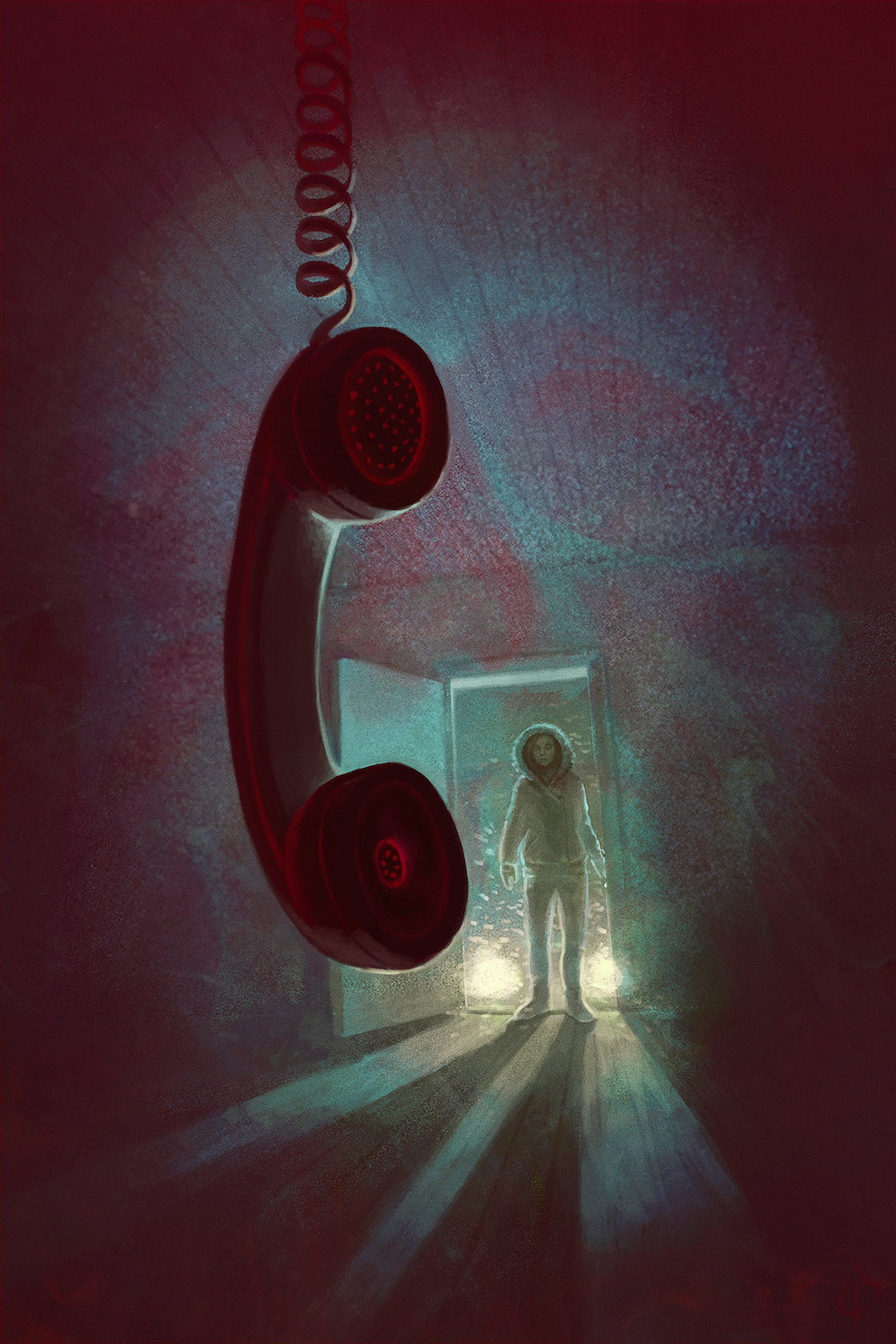
Okay, Landline. This was a really good horror story, about a teacher about to get on a plane to go to London with her students, when her six-year-old son calls her and says Daddy is gone and he’s hiding alone under the table in the dark. She rushes home, only to find him gone without a trace. As she frantically searches for him, we learn things about her husband that make the whole situation more terrifying.
It was so well written, so scary, and I was so tense reading it. But then… I really didn’t like the end. It was very up for interpretation, but the feeling was more confusion than terror. Judging from the comments, I think a lot of other people were confused too. There were a couple of ideas about the ending that I liked, but nothing that explained everything. It’s like the ending works metaphorically, but at the expense of logically.
Well written, but the ending did make this a miss for me.
_________________________________________
Okay, that’s most of the award nominated short stories of this award cycle.
Now I wonder if I have time to talk about novelettes too?
Maybe.
Until then, happy reading.
~ Jayde

