

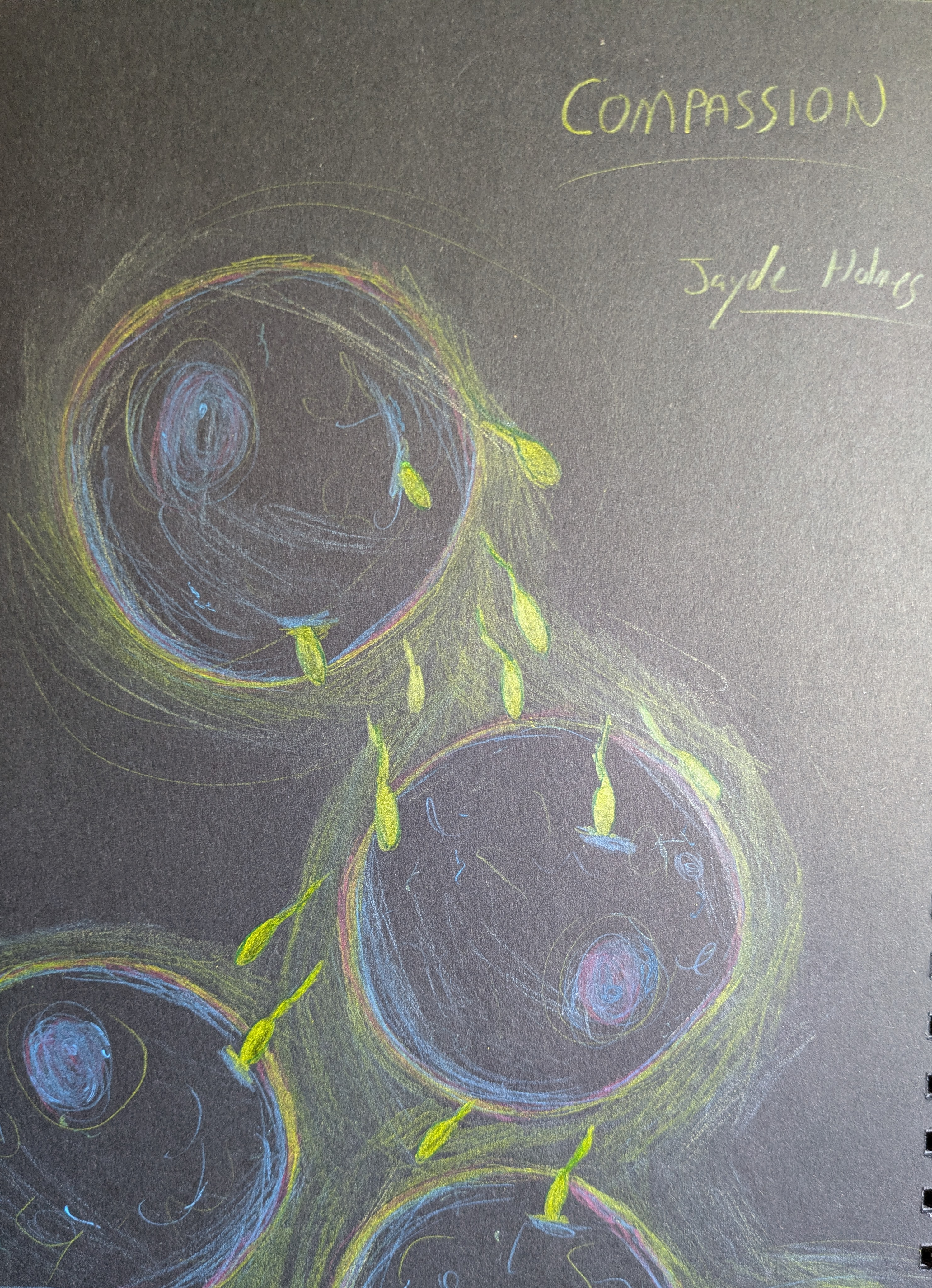
2026 Monthly Story Challenge #11
Compassion (Wordcount: 9337)
By Jayde Holmes
“I’ve destroyed every record of the sub-space path I could access. I know that won’t stop them for long, but I just need a little time. I know the risk I’m taking, but The World could be destroyed, and despite all that happened, I cannot bear that thought. [cont…]”
~ Final Message from Dr. Gloria Mendez
A burning scorch cut through our forest as something fell from the sky. Hundreds of trees and animals died, as well as thousands of insects and a heartbreakingly high number of microbes. We responded fast. We sent burrowers and water carriers into the area to douse the flames. We pushed the woody plants to enter a state of hyper-growth in the hope that they could regrow their bark, and those that were doomed we set to compost or germinate. We gathered hundreds of insectivores and flyers at the edge of the damage, ready to process the bodies once it was safe.
We have adaptations for making the most of fire, but it is rare for the phenomena to happen at this scale so quickly. We read the memories in the rocks and found mention of meteorites that had caused similar damage in the past, but the memories were not a perfect match. The object that had landed was not the correct shape or composition, nor had we ever seen a hole appear on the side of a meteorite that strange bipedal creatures ran out of it.
We were not in the creatures. We could not feel them. It had been horrible enough not being able to sense the meteorite, but these were living creatures of flesh whose bodies were silent. That happens sometimes, when mutations in the colony organelles create colony that communicates on a different frequency, but we don’t let that go unchecked long enough to isolate multicellular organisms.
Was their colony sufficient for them? Could it care for the creatures after such a fall?
One of the creatures collapsed to the scorched ground with foreign material embedded in its abdomen. We watched it wither and scream; obvious signals of distress, but there were no signs of healing or of euthanasia in response.
This silent colony didn’t seem to be doing anything to help that creature.
None of the other creatures touched the injured one to transfer additional; colony cells. They were all panicked as if there was nothing directing their actions. They were in such obvious distress that we could sense it even without access to their cells, but nothing was happening to help them.
It was as if their colony organelles had completely malfunctioned.
We had to help.
We gathered every insect, mobile fungi, worm and bacterium in the nearby soil and moved to the fallen creature. We swarmed it, seeping into its skin and through its open wounds. It had a protective barrier unlike anything we’d ever encountered, and then a layer of skin that was even more impenetrable. It was a cruel design that we’ve never dreamt of in all the billion years of our memory. We pushed through the outer barrier and directed our swarm to the wound. We poured as many colony organelles as each of our creatures could spare into this new being.
Meanwhile, a train of large terrestrial animals with massive mouths full of water arrived to douse the meteorite. We prioritised the two alien creatures that were on fire, even after the flames had gone out. As tough as their skin was, it did not appear to be fireproof. What a terrible design! Why go to the trouble to make skin that kept out microbes without attempting fireproofing?
When the first of the watercarriers had tossed its load onto the flames, we made it go inside the meteorite to investigate. We found two more alien creatures. One was holding the limp second alien.
Was the second alien dead? If so, there seemed to be no repurposing of its body happening.
We’d already woken nearby large carnivores from their hibernation to deal with the animals that had died, but we spurred the nearest one to come immediately.
These poor, poor creatures. We’ll do what we can to save them.
Gloria found herself sitting against the hull of the burnt-out ship, hugging herself as she watched a group of alien woodland critters put out the fire and stare at two crew members with burn injuries.
They’d set up their orbital satellites, received confirmation that the atmosphere wasn’t toxic, and then picked a landing site in a plain of pink grass on the planet’s dayside. It had seemed open enough to be safe, and strange enough to warrant investigation. But they’d struck something whilst in the upper atmosphere and come crashing down engulfed in fire and alarms.
Now the fire from their violent atmospheric entry was being doused by creatures that looked like giant, armoured frogs with giraffe legs. They were taller than her and spilling water everywhere, whilst small rabbit-like creatures kicked dirt on the flames they missed.
She’d seen dozens of alien ecosystems and could tell immediately that these animals were wrong. Even in her shock, she couldn’t help trying to imagine a path for these fire-fighting frogs to evolve, and she saw no feasible way it could happen.
Dale the ansible tech sat down next to her. He was tall, buff, young, and looked scared out of his mind. He had a small cut on his forehead that someone had pasted what looked like a leaf over. It was hard to see what it was in the dark. They sat in silence for a while. Dale kept opening his mouth as if there was something he needed to tell her, but then he fell silent again, as if it was too hard to say it.
“Something is wrong with the doctor” he finally said. “Can you…?”
“Of course” Gloria said, happy to have something to do besides dwell on the wrongness of the animals. They walked around the ruins of the shuttle, and Gloria saw three other members of the crew sitting around in similar states of shock. Anisha, the geologist, was laying down crying with a rabbit-like creature on her chest. The rabbit-like was purring and allowing Anisha to pat it.
Infront of the shuttle exit hatch Miles the botanist was holding Dr. Igwe’s hand as she sobbed. She was rolled on her side and had a large piece of shrapnel lodged in her abdomen. In the light of Mile’s torch, Gloria saw the shrapnel was held in place by a yellow paste full of worms.
“Holy shit” Gloria said, running towards the two figures and dropping to Igwe’s side. “Holy shit what is that?”
“I think it’s why I’m still alive” Igwe said through gritted teeth. “They’ve sealed the wound and they’re applying pressure. But I feel burning.”
“Around the wound?” Gloria asked.
“Everywhere” Igwe said. “Probably xeno-contamination.”
“Get my lab kit” Gloria said to Dale. She had jars of anti-xeno nanites she could inject into Igwe. Her only concern was that if the worms and their excretions were keeping Igwe alive, would killing them kill Igwe?
“And get a first aid kit too” she called out to Dale as he ran off.
She tried to roll Igwe over, but the doctor hissed in pain and told her to stop.
“Something is holding me in place” Igwe said. “I don’t know… I can’t move.”
Gloria got on the ground and tried to pry Igwe up. A white fungus-like organism was connecting her to the ground. This thing and burnt holes through her shirt and was hooked into her skin. Gloria wrapped her hand in the end of her shirt and pulled some threads away from Igwe. They resisted, but they came away. As they did, they left tiny splotches of yellow gunk and red blood on Gloria’s shirt.
“What’s happening?” Igwe asked.
“We need to get you off the ground” Gloria said.
“Why?”
“Are you sure that’s safe?” Miles asked.
“We need to move her now” Gloria said as she noticed pinpricks of blood forming on the tattered section of Igwe’s shirt where the fungus had been attached. She tried to lift Igwe, but even without the fungus pulling her to the ground, Gloria couldn’t wasn’t strong enough. Not even when she saw the ground beneath Igwe bloom and felt her heartbeat accelerate.
Miles helped her lift Igwe into a sitting position, then Dale returned with the medical supplies. Gloria screamed at him to spray Igwe’s back and help get her to the shuttle. He looked confused for a few seconds, then saw the rapidly growing fungus on the ground reaching up to Igwe’s raised back and swore. He dropped the first aid kit and went rummaging through her lab kit. He found a tube of anti-xeno and a spray gun. He combined them with shaking hands then sprayed Igwe’s back, causing the fungal strands to drop away and wither.
As the fungus retreated, all the animals in the clearing froze. Some of the tall frogs spat out their mouthfuls of water and grouped together, grunting. Most of the rabbit-likes ran, but Gloria saw one close-by staring at the spray gun in Dale’s hands, it’s nose flickering. Even the noises of insects and rustling plants that had been too faint for her to pay attention to ceased.
It was as if the entire planet had fallen silent.
Igwe screamed and cupped a hand to the wound on her abdomen. Gloria saw the worms burrowing deeper into the yellow paste. Dale swore again as the rabbit-like slowly hopped towards them, cautiously and without taking its eyes off the spray gun.
“BACK IN THE SHUTTLE!” Gloria screamed. “Everyone in! NOW!”
She and Miles yanked Igwe up, screaming as her shoulders protested. Dale jumped towards them and helped keep Igwe steady. Together, they dragged her up the stairs and into the shuttle, with the rabbit-like following close behind. It didn’t run.
As they got to the hatch Gloria heard rustling coming from the trees. She looked up at the canopy. The trees were moving, as if making a path for something large.
The rest of the crew rushed in, crying even though they hadn’t seen the fungus. In the stampede, the rabbit-like got kicked around and rolled off the stairs. Gloria expected it would run away. It was so obviously a small prey animal, so it must be just as terrified as them.
Instead it got up, shook itself, then hopped back onto the stairs, making its way towards them at the same casual pace as before.
“Hell no!” Gloria said. She left Dale and Miles to find get Igwe into the medbay and ran back to the hatch. She kicked the rabbit-like away. It didn’t even dodge. Then she made a quick headcount. Once sure everyone was inside, she slammed the hatch closed.
She got a glimpse of the rabbit-like before she did. It looked up at her. It had pink and yellow blood oozing out of a cut on its head. It was slack jawed and its nose was twitching.
It still didn’t run away.
We couldn’t make sense of what was happening. The creatures had tools that we’d never imagined before, and it took every mind on the planet hours to work out what they might be. Metals striped of rock and impurities into tools for spraying some sort of monster cell.
We battled against the monster cells. They did not show any signs of stress or provide any familiar chemicals. They just killed all other cells they came across.
We concluded that the monster cells were also made of metal. Maybe such a monster could have evolved naturally. There are notes in the rocks about different types of cells that had no colony organelles, but they were done at a time when notes were just scratches to tell future generations where to find food and hiding places. No information is preserved over these final remnants from the dawn of cellular life, besides a hint that uncontrollable predatory creatures made with non-colony cells had once existed.
A more disturbing prospect was that the creatures from the metal meteorite might have made these cells. Maybe they were a tool, but why make something purely to kill? The monsters had left the tips of the fungus poisoned. We weren’t even sure if the remains could be recycled.
It must have been made for some sort of disease control, even though we’d eradicated all viruses we could a billion years ago. Considering that idea as well as the unfamiliarity of the creatures and their tools, plus their arrival from the sky, we concluded that they were not from our planet.
A terrifying concept. Life unknown. Life we hadn’t spent billions of years cultivating. Life that had no place in our ecosystems.
If correct, it was prudent of the aliens to stop the cross-colonization. We have no idea how two different microbial environments would have reacted, and judging by their advanced metals, they were more knowledgeable. Perhaps in our eagerness to help the creature that had fallen, we might have inflicted unintentional pain.
Even with these revelations, we were concerned. We didn’t know if the creatures were connected like life on our planet, or if they were isolated like the almost forgotten alternate microbes of the very distant past.
It seemed unlikely they were isolated. Their tools used metal in ways that we had never dreamt of. With so many minds contemplating what we’d seen, we were starting to see how we could recreate some of their alloys, but we’d never thought to use fire to shape metal like this. The mental processing power needed to come up with such an idea would require billions and billions of minds and a method of inscribing memories much more sophisticated than ours. Ten large multicellular creatures with only one brain apiece wouldn’t be enough.
But they were in such a panic. They cowered and screamed and ran like animals whose cells became unable to produce healthy colony organelles. Besides a simple blood coagulant reaction and some sort of cellular defence system, we haven’t encountered anything inside the alien we infested helping it heal or even easing its pain.
Of course, it is hard to know for sure, since the other aliens have injected the monster cells into it.
We stopped excreting colony into it, but they didn’t care, they just kept injecting more monsters! Even though it hurts their own fellow creature. They put some other chemicals in it that we think might be painkillers, but the metal monster cells still rip through the creature’s bloodstream. They don’t kill its cells like it does ours, but they must hurt. Do they not see how much distress they are causing?
The worms have it worst. There are monster cells in the alien’s tissue that chase down the worms we made hide. Once they find a worm, they surround it and drag it back to the open wound, not caring if they kill it in the process.
Worse, the creatures grabbed some of the worms and killed them intentionally! They didn’t eat them or use them as a medicine; they just squished them!
We cannot fathom why.
We signalled the colony to commence the euthanasia sequence of the worms, hoping to spare them distress. Most were spared from the squishing, but the aliens started putting some in a freezing box, lowering their body temperature so low that even the euthanasia sequence was stopped.
We have all the aliens and surfaces inside the meteorite covered in microbes but are too afraid to do anything that could alert the aliens to their presence.
Maybe these creatures are cut off from their ecosystem and have therefore been cut off from whatever mechanism unites their world. If so, we could be facing unintelligent, terrified creatures with a limited understanding of the tools they are using.
The first thing we need to do is establish if they feel any form of compassion. We’d sent a small creature to investigate one of their tools, and it had been almost trampled in a panicked stampede. That was understandable considering the state the aliens were in, but something disturbing happened afterwards. One of the aliens turned around and kicked our burrower so hard it flew off the steps and cut its forehead open.
We cannot imagine any reason why any creature would go out of its way to cause needless harm like that.
We gave the injured creature a poultice and made it climb to the top of the meteorite, to a transparent spot near the front. Now it sits on the transparent spot and can see all the aliens huddled around their injured one and their dead one. The aliens saw us and made loud, disturbing vocalisations. The burrow seemed able to tolerate a bit of pain, so we had it scrape the poultice off and let its natural healing processes take over. We hoped letting the aliens see the damage they had done and the distress they’d caused might alert them to their reckless behaviour. Blood dripped from our burrower’s head as it watched the aliens.
They took an interest in it, but they looked as if their distress was growing. We couldn’t tell if it was a result of seeing the burrower’s pain, or of being trapped in a small space with a dead body.
We made the approaching carnivore move faster. We need to get the dead body away from them if we want them to settle. And if they are curious, then maybe we can get them to understand that we can learn about them by processing their dead one.
Igwe was stabilised in the medbay, which also doubled as a basic lab. We’d taken samples of the worms, fungus, and other local excretions from her and put them into cold storage. The equipment for their proper lab, including the fabricator-tank that would make the lab and their other living modules, was in the storage area at the back on the shuttle.
Gloria left Igwe in the medbay with Dale, but kept the door open so they could see and hear everything in the cabin. They had such a small space, with most of the room taken up by their seats, the walls covered in screens, and the only other internal room being the head, which sat opposite the medbay.
Gloria saw the rabbit-like on the windshield immediately. It was staring in at them, with a cut on its forehead that dripped blood. It had seemed terrified at first, then its face had gone slack and it just stared at us in a stupor as the cut on its forehead healed unnaturally fast.
It was like they were being taunted. She didn’t think it was the rabbit-like doing the taunting. As she replayed her memories of the crash and the strange actions of the plants and animals around them, she got the feeling that there was some unseen force controlling them. The rabbit-like and the tall-frogs didn’t act like real animals. They were marionettes, and she couldn’t imagine how the puppet master was controlling them.
She couldn’t imagine what that poor rabbit-like must feel, being dominated so completely. Her daughter had pet rabbits. She knew they didn’t have a lot of thoughts in their little minds, but they still had minds of their own. This poor creature didn’t.
One of their pilots, James, had died in the crash. They didn’t have any way to preserve his body, so they settled for covering him in a blanket from his disaster kit and taking turns eulogising him. This was only the second expedition this team had been on together, but he had been friendly enough that everyone had something to say.
Gloria got halfway through retelling the story of when she’d met James, but then she caught a glimpse of the rabbit-like at the window and burst into tears. She imagined them all being infected with the fungus that had tried to get Igwe and realised that if that happened then she might not even care about James’s death.
She pulled herself together and got through the rest of the story. She didn’t tell everyone about her horrific impressions of the native wildlife though. They already had too much to worry about.
Their other pilot, Yusra, had been grief-stricken to the point of incoherence when they returned to the shuttle. She’d refused to let go of his body or get her own burns treated at first. Once Gloria and the rest of the crew started working on Igwe, Miles had sat with her and helped her calm down. He helped her cover James and treated her burns.
As the team pulled a constant stream of worms out of Igwe and tried to preserve or destroy them, Yusra got back in her pilot’s seat and checked the shuttle systems. She got all the internal systems back online, allowing them to snap freeze and store some of the last worms they gathered. She took a short break to join James’s vigil, then went back to her chair and got the outside cameras running again.
The wall screens now revealed that the shuttle was surrounded by the tall-frogs, rabbit-likes and many other strange creatures. There were two snake-like creatures at the front of the crowd that sparkled as if covered in gemstones. All the creatures stood still and stared at the shuttle.
Gloria looked from the screen to the window with the bleeding rabbit-like. The rest of the crew were also muttering about how unnatural the animals were.
“It seems we hit a swarm of creatures in the clouds” Yusra said, replacing the view from the cameras with a recording of their descent. A giant swarm of gliding creatures got caught in their path. They’d hung in the air like kites with minimal flapping, but they hadn’t even noticed the shuttle approaching from above and had barely any manoeuvrability. As Gloria watched the recording, one of the gliders whipped past the camera, and she saw it had a massive eyeball on its belly.
What a ridiculous creature. It was as if its features were there not to contribute to its own fitness but instead were chosen by some deranged creator that wanted to survey its entire planet.
“We’re still able to take off” Yusra said. “But it would be a full-thrust ascent and will scorch the surrounding area. We can’t do a non-destructive landing or take-off anymore, so if we want to leave, I suggest we abort the mission completely. We probably should anyway. Your orders Team Leader?”
Everyone turned to look at Gloria. They’d been so informal before the crash that it took her a moment to realise Yusra was talking to her.
“Just go” Gloria said. “This area is already damaged, and Igwe needs better treatment than what we can provide. Play the deterrence sequence then take off once the local fauna scatters.”
She expected at least a token pushback from the other scientists about the wasted opportunity to explore, but what had happened to James and Igwe was serious enough to make everyone see sense. Yusra activated the deterrence sequence; a set of sounds and flashing lights that mimicked common threat displays from ecosystems across the galaxy.
The animals jumped back startled.
Then they crept forward.
Curiously. Frightened, but in the same way a human or pet encountering something vaguely unfamiliar got. They had no instinctual fear of the bright colours or scream-like sirens. It was as if they had never encountered a creature that needed to growl a warning or show off its dangerous venom.
“They’re actually coming closer” Yusra said.
“How the fuck do any of these things survive?” asked one of the other biologists with a nervous laugh. Gloria wondered if he had the same impression of the local fauna as her, but she didn’t risk asking. She knew it was a crazy idea, and right now, the team couldn’t afford to be frightened by something so unlikely.
“Try starting the engine” Gloria said. “Maybe it’ll sound like thunder to them. And they’ll feel the heat from the thrusters. That should get them to back off.”
Yusra started up the engines, and the gathered creatures backed away right up to the edge of the clearing. Even the injured rabbit-like awakened from its stupor and ran into the trees. They didn’t flee completely. The camera could still see the heads of tall-frogs and rabbit-likes poking through the trees, continuing to watch them.
Gloria was about to order the team to secure Igwe and James’s body and prepare for take-off, when Yusra swore.
“What are they doing?” Gloria said, rushing over to Yusra’s screen.
“What, no, nothing from the animals” Yusra said. “It’s the wormhole navigator. One of the main dishes came off and we don’t have enough fuel to manually plot our subspace route in space before we lose life support. We’ll have to send a sub-space probe up and calculate the route on planet.”
Everyone swore at that. Gloria looked around their small shuttle. They were trapped in this tiny space, with a dead body inside and an army of strange animals outside. The thought spending days cooped up in the shuttle was unbearable to Gloria. She looked around at the team. Igwe was looking out from the medbay, clammy and shaking. Dale was holding her hand, and his eyes went wide as Yusra’s words sunk in. She could see other team members fighting back tears or turning away so no-one would watch them break down. Miles was hyperventilating.
“No chance we can repair the broken dish?” Gloria asked.
“Ahmed, take a look at these readings and see if it’s fixable please” Yusra said, beckoning the team mechanic over. “I’ll ping the dish’s chip and see if it’s close.”
Ahmed joined Yusra at the controls and Gloria stood back, trying not to hold her breath as she awaited their verdict. She looked beyond them through the windscreen, making sure the bleeding rabbit-like hadn’t returned. Then she heard Miles freak out and turned around. The team were all staring at the screen. Miles had rushed over to it and played with the settings until the view stayed with the camera at the back of the shuttle that overlooked the engines.
A single tall-frog was walking towards them, stride unhurried yet unafraid. Its mouth was full of water, and it was headed towards the thrusters, which were glowing orange while on standby.
“Ahmed” Gloria said. “Would it be bad if the local fauna tries to extinguish our thrusters?”
“If they all started doing it constantly the steam could cause damage” he said, looking at tall-frog on the cabin screen with worry.
“I’ll cut the engines” Yusra said, flicking some switches as she spoke. The shuttle went quite as the engines turned off, and the tall-frog stopped before the now cooling engines. It didn’t seem capable of moving its head enough to examine the thrusters with such a large mouthful of water, but three rabbit-likes ran out from the nearby trees and began sniffing and searching around the back of the shuttle.
“They might be intelligent” said Emrys, one of the other biologists.
“The hoppy things or the long-legs?” asked Chris, the other biologist, whose arm was now terribly burnt.
“Everything” Emrys said.
“That’s impossible” Chris said. “They don’t have any physical traits associated with large brains or complex lifestyles.”
“But they aren’t acting natural.”
“True. What do you think Gloria?”
“I just want to get us to safety” Gloria said. “We can look over the footage and samples and try to figure out what’s going on when we return.”
If we return, she thought. Nearly every other planet she’d been on she still longed to visit again. Even on that one where every plant had evolved black leaves and the camouflage of the local fauna had resulted in creatures that to her earthborn eyes looked monstrous. No other ecosystem had ever unnerved her as much as this one had, but she knew it was possible that the shock of the crash and James’s death was making everything seem terrifying.
She hoped that was the case.
“The big-mouth is walking again” Miles said.
“Beep the horn” someone else yelled to Yusra.
“Do it” Gloria agreed.
The shuttle didn’t have a horn, but someone had added an airhorn sound they could play over the speakers. Yusra played it, and the rabbit-likes investigating the shuttle sprung back in unison then ran behind the tall-frog. The tall-frog had startled a bit, spilling some water, but then it continued towards the thrusters.
Almost as if it had been designed to be a stoic firefighter that walked into danger.
“Keep honking” Gloria said.
Yusra kept playing the horn sound as the tall-frog approached. It hovered over the thruster, then it dumped a mouthful onto it.
“Like, it won’t destroy things like that” Ahmed said. “But, we’re sure to have some damage there from the crash, so this is unpredictable. Especially if they all start fire-fighting and keep at it like they did with the forest fire. Anyways, I think we can fix the navigator as long as we can get the dish and it’s in one piece.”
“Even better news, it’s only six hundred meters behind us” Yusra said. “Shouldn’t be on the edge of the trail. The chips of the other components attached to the dish are all pinging from the same location, so it’s in one piece. There are other sensors that came off, but nothing critical for the trip home.”
“We’d have to go back out there and get it” Miles said. “We’d have to go through them” He was flickering through the different camera feeds, following the tall-frog as it walked away from the thrusters. It went back to the edge of the clearing, where a group of tall-frogs with mouthfuls had gathered.
“I don’t want to spend a day or two getting our shuttle doused” Ahmed said.
“What should we do team lead?” Yusra asked.
“I know tonight has been terrifying” Gloria said. “But the fauna” – she nodded at Igwe and Dale in the medbay “-at least hasn’t made any hostile moves. In fact, they helped us when we all ran out of the shuttle. We need to get Igwe to a hospital. And James… James needs to go home as soon as possible. I’ll go get the dish. I want two uninjured volunteers to come with me. Then once we’re back Ahmed will come out and we’ll guard him as he reattaches it. We’ll each take a large spray can of anti-xeno. Maybe that blowtorch we can turn into a flamethrower or a machete too. And no sitting down or standing still or making any unnecessary contact with the ground. Sound good?”
Everyone nodded.
Then slowly, they all saw movement on the screen and tensed up again.
Gloria around just in time to see the tall-frogs part to make way for three other creatures. The two glittery snakes from before slithered towards the shuttle, flanking a new monster.
It was a tall thin quadruped with reptilian skin that walked with mammalian swagger. It had a heavy crocodilian head on the end of a long neck. Its strong jaw gaped as it approached, letting them see its massive, multiple rows of sharp teeth. Its paws ended in raptor claws that bobbed as it walked, and its forelegs were covered with a range of different blades, as if it were prepared to rip through any natural armour.
“What the fuck is that?” Miles asked, backing away from the screen.
“And there have to be snakes too” Emerys muttered.
Gloria watched as the deadly trio approached the shuttle hatch. The snakes coiled at the bottom of the stairs as the blade-monster climbed. After a few seconds it began scratching the door. They heard the massive raptor claw against the metal like nails on a chalkboard.
“Yusra” Gloria said, unable to take her eyes off the door “launch the probe anyway. I think we can make it back away, but… but you should launch the probe just in case.”
We don’t know what we’re doing. We want to help the aliens but we cannot tell if we are reading their reactions correctly.
We read their body language when they landed as distressed and in pain. When we see them through the clear part of their meteorite, we still get that impression. They make sounds and gestures just like our animals. Maybe that is a universal feature animals use to provide feedback regarding their state of being. We must consider though that animals in a different ecosystem might use completely different sounds and actions to convey their needs.
Reading their communication cues as distress after they had crashed and were surrounded by fire had seemed correct, but they were still vocalising in a similar way whilst safe in what had to be their nest. These could be expressing joy, or maybe just making sounds that they found pleasing. The sounds and actions we have seen emerge for happiness are a lot more varied in our ecosystem than the sounds to express pain, so reading their behaviour as contentment is valid.
But they still look so distressed to us.
What if they are always distressed? What evil ecosystem would design such a life for an animal?
They seemed to be directing their vocalisations at each other, which had to mean that these were sounds of content right? Why would animals direct distressing vocalizations to another individual, rather than the meteorite that appeared to be part of their ecosystem.
We directed two aesthetically pleasing creatures to the crash site. Two slithering creatures with the most elaborate pattern of coloured scales we could breed. The aliens had reacted to this display of beauty with one of their own. The entire meteorite had lit up with beautiful colours that danced over its surface. We watched transfixed and felt a sense of excitement at the prospect of a new ecosystem. We may not understand how it works, but it has a sense of beauty. It can take pleasure in things not needed for survival. As terrifying as the thought of life outside our control was, there could be value in coexisting with an entity like that.
But while it was creating such a stunning visual display, it was emitting sounds that to us sounded as if it was in pain. Maybe it was transmitting its creature’s pain, the same way we had when we’d made the injured creature stand on their transparent opening.
But why would they combine such an expression with something so beautiful?
As the night went on and we struggled to decipher the actions of the creatures and their meteorite, we were faced with the disturbing possibility that the alien ecosystem was indifferent to suffering and joy.
The revelation was almost as unsettling as what we observed while investigating the alien skin and blood cells scattered around the crash site.
The hardest part was piercing the cells walls with our colony organelles. Impenetrable barries seemed to be a theme. We shuddered to think what viruses or other uncontrollable contagions could warrant such adaptions. All life we know has permeable cell walls, allowing for the colony to spread to wherever it is most needed.
By the time we pierced through the alien cells, we had come to expect a layout as incomprehensible as everything else we’d encountered tonight. However, the cell structure was recognizable. The aliens had a cytoskeleton maintaining the cell shape and a nucleus containing information, though it was encoded in a structure our colony organelles couldn’t create an imprint of, so it was impossible to examine. They were also full of various organisms, including many cilia and flagella that looked almost indistinguishable from our own.
We absorbed some of these moving organelles, hoping to identify the alien colony. No organelles gave off their own electrical frequency, so we couldn’t identify the alien colony that way. Instead, we carried some of our lysosomes over to break down the most promising flagella and used the imprinting functions of the colony cells to examine them molecule by molecule.
None of the flagella we sampled were complex enough or numerous enough to be colony cells. The organelle most like our colony was a double-membraned circular organelle containing a structure that resembled the information strands in the cell nucleus. We quickly observed that it was the powerhouse of the cell, creating energy just as colony cells did. Further tests revealed it performed many of the same functions as colony cells, such as signalling and controlling cell death. Towards dawn, we even managed to observe a cell-cell transfer of these powerhouse cells.
The process was not as simple as it was for our colony cells, and without imprinting or broadcasting capabilities, we didn’t see how these organelles could manage multicellular organisms. Especially when there were so few of them.
Whilst we investigated these alien cells, our multicellular drama continued to play out. We weren’t sure what we should do about the extreme heat coming from what we were beginning to think of as the back of the meteorite. We had observed that the alien animals were harmed by fire, so we wanted to make sure their meteorite didn’t become engulfed in flames again.
But the meteorite’s sounds and the reactions of the alien creatures as our water carrying creature approached made us think they saw this as a harmful action. When our creatures got close the back of the meteorite became enflamed. Did proximity trigger fire? A lifeform made of refined metal could use fire for metabolic reasons. However, there was the possibility that the meteorite could be damaged, and maybe the creatures were unaware of the possibility that they might become entombed in fire again.
We kept our water carriers nearby with their mouths full. We focused our efforts on getting the carnivore to the clearing. It arrived at dawn, not long after we had finished experimenting with the alien cells. We sent it up the sealed opening at the side of the meteorite, flanked by the two aesthetically pleasing slithering creatures the meteorite had reacted to earlier.
We spent an hour having the carnivore scratch at the door, hoping the creatures would understand they could give their dead one to it for study, even if our cellular structure made reclamation unlikely.
We couldn’t tell if they understood or not. The alien creatures inside alternated between huddling together and gathering up their tools. Our more optimistic minds felt that maybe they were getting ready to aid our carnivore.
We thought it would help if we also provided them with a corpse. We used a flying creature to pick up a small animal that had been killed by the meteorite’s landing and dropped it on the transparent part of the meteorite’s exterior. We used the surviving colony cells within the dead creature to make the body twitch so the aliens would see it.
The carnivore became uncomfortable, so we took it away from the meteorite opening to attend to its bodily functions. Once we stepped away from the opening, it unsealed and one of the alien creatures jumped out.
It was screaming.
It held a tool with a long, warm metal pole that reminded us of the warm openings at the back of the meteorite that we’d tried to douse. The tip of the tool heated up just as the back of the meteorite had, and then a stream of fire shot out of it towards the aesthetically pleasing slithering creatures, who barely jerked away in time.
The alien came down the stairs, screaming at our creatures and shooting bursts of fire towards them, even as we retreated. Two more aliens followed, holding larger versions of the tools that sprayed clouds of the metal monster cells. The opening resealed behind them.
Millions of minds around the planet that had been pondering the tools and the strange, heated parts of the meteorite reached an epiphany.
The meteorite itself could spit out fire just like this new tool. Metal and fire were as much a part of their ecosystem as flesh and blood, and their colony cells did not care what impact those components had on its own world. Their colony was indifferent to its creatures, who as they ran directed the same angry screams they’d given to our creatures at each other.
Compassion and pain were not important to the alien ecosystem. Maybe it didn’t even notice those things. We had to assume that they were going to restart the fire that had surrounded their meteorite, and that this dash through the forest was towards that end.
We couldn’t imagine why. We doubted it was possible to understand why these thoughtless creatures did anything, but we had to stop them.
We must stop them because there are still plants and fungi and a whole host of micro-organisms around that meteorite. Organisms that had survived the initial crash and fire and that could not be relocated as the animals could.
And we are not indifferent.
We have compassion for every creature that makes up our being, and we will not subject them to the incomprehensible destruction of these thoughtless, empty-celled, unfathomable monsters.
The alien monsters bolted away from the clearing, following the path of destruction their meteorite had carved through our forest. A gash through hundreds of innocent trees, damaged or dead. They ran through a scare on our body, and we chased them. We followed with our flying creatures, and with our blade-covered carnivore.
We couldn’t understand what they were doing, but we wouldn’t let them cause any more pain.
Gloria ran through the alien forest with the flamethrower held high, Dale and Emrys at her sides with their own weapons. The blade-covered predator chased them, which was terrifying at first, but as they listened to it trip over its own feet Gloria found herself giggling. It’s two raptor-like claws were the middle claws of the foot, instead of at the side. It was as if it had never had to chase down its prey before.
“What’s so funny?” Emrys snapped.
“Nothing” Gloria said, remembering how freaked out Emerys had been at the sight of that twitching dead rabbit-like dropped on their windshield. They didn’t need a reminder about how unnatural the ecosystem was.
The bird-like creatures were a bigger threat. They swooped down and we wasted a lot of anti-xeno nanites and the flamethrower’s fuel fending them off. They dodged the anti-xenos, but Gloria got one with the flamethrower. As the burning bird-like fell to the ground with a scream, a massive rumble rose from the forest. The ground shook as what sounded like every living organism capable of making a sound cried out in outrage.
They stopped and stood back-to-back, scanning for an incoming threat. The bird-likes weren’t attacking; they’d landed next to their fallen comrade and were flapping dirt at it. Gloria scanned the trees, and for a moment her heart skipped a beat. It was the first time she’d looked at the trees in the light of day. Or at least, looked beyond the burnt and broken trees on the edge of the scorch their shuttle had made.
The trees were breathtakingly beautiful. There was no uniform colour amongst the leaves and bark. There were giant fanleaves in shades of indigo, surrounded by long stems of marble white and grey sprouting shiny green berries speckled on the trunk. She saw tiny red leaves surrounding black flowers. Stringy leaves falling down a black trunk like hair dyed a rainbow ombré. Flowers with dainty petals transparent like glass, reflecting the light of the dawning sun over still flat blue leaves. Everywhere she looked, she found a different colour or decorative feature.
Whatever celestial tyrant was controlling the life on this world, it had put a lot of effort into making everything beautiful.
“We need to go” Dale said, pointing his anti-xeno spray back the way they’d came, to where they could see the predator catching up to them. Gloria and Dale ran. Emerys followed after a moment, as if they too were entranced by the beauty of the forest in the morning light.
They found the dish to the side of the scorch, tangled in a burnt shrub surrounded by similar undamaged lants sporting transparent dew-drop berries. It appeared intact and was covered in fine, silk-like red threads.
They started running back down the scorch, with Dale and Emerys holding the dish whilst Gloria kept the flamethrower ready. They slowed as they realised that the predator and the birds were sitting where they left them. The flames had been beaten out, but the animals stayed in place, spread out to block them.
The two groups met, cautiously edging towards each other. Gloria and the predator stepped away from their fellows, eyeing each other up. The predator stalked towards Gloria, body lowered as if trying to line up a pounce but making sounds that reminded her of a scared puppy.
She held her weapon, pointing it at the predator. Her hands were shaking.
One blast. She was close enough to get it. She could stop it forever, and even if she didn’t, it wouldn’t stay and fight. The injured bird-like was already hiding amongst obsidian black tree trunks whilst the others guarded it. One blast and they’d be safe.
But she had come here to study alien life, not destroy it. She thought of flamethrowers and bulldozers being unleashed on this beautiful rainbow forest.
Then she thought of Igwe screaming as the worms were dragged out of her wound. She thrust the flamethrower forward, but her hands were shaking so much she missed the trigger.
The predator lunged towards her but pulled back at her flinch. They circled each other, Gloria’s knees shook as she moved, and her eyes didn’t leave the monster before her, who with every second was looking more and more pathetic. Was it a puppet? An innocent animal that had been twisted into this ineffective beast by an entity that didn’t even know what skills a predator needed to stay alive?
She kept stepping around the predator, then realised that now it was no longer standing between her and the shuttle. She looked between the predator and the shuttle, and then towards Dale and Emerys, who both looked confused. She stepped closer to the predator, turning her flamethrower around and waving the butt of it in the monster’s direction.
“Shoo!” Gloria shouted.
The predator backed off with a whimper.
She stared at it, then beckoned Dale and Emerys to follow as she ran back to the shuttle.
The predator and the bird-likes followed, but slowly. They were not harassed for the rest of the trip, and when they returned none of the other creatures challenged them. The local wildlife stood still and watched as they let Ahmed out of the shuttle, and as he re-attached the dish to the shuttle.
As Ahmed worked, Gloria found herself on top of the shuttle, gazing out over multicoloured treetops that glittered in the morning light. It was so beautiful, but so unnaturally quiet.
Once done they went back into the shuttle. Nothing tried to stop them.
Gloria took one last look at all the animals gathered in the clearing to stare at them. The tall-frogs with their mouthfuls of water were still there. It seemed like there were hundreds of them now, many tucked away in the trees. There were rabbit-likes, bird-likes, the snake things and the predator, plus carpets of insects, all watching the shuttle in dead silence.
She sealed the door behind her and got the crew prepared for take-off. Once Yusra confirmed they had a path through the sub-space wormhole confirmed, they engaged the thrusters and took off. The animals scattered, and another large swathe of trees were annihilated as they rose.
Then they shot into the sky and through the wormhole. Away from the nightmare world, and off to their loved ones where they were safe and taken care of.
The meteorite flew back to the sky, killing and burning thousands of organisms in the process. Just as we feared, the aliens had no regard for the plants and fungi and microbes that couldn’t move out of the way.
We had known this catastrophe would happen, but we’d been unable to bring ourselves to prevent it.
Maybe it was due to the fear of hurting more animals, the way the flyer had been hurt when the alien turned its fire tool on it.
Maybe it was the carnivore’s instincts, that had rebelled so much at the thought of harming another creature. Carnivores weren’t supposed to kill healthy, scared creatures. They were supposed to give the injured and the sick a quick end.
Maybe it was due to how terrified the alien had looked. It reminded us so much like an animal with a cellular deficiency that impacted our ability to keep it healthy and safe. It wasn’t an exact match, but the sight of the poor alien triggered an urge to help it that we’d never had reason to question before.
We had never considered that compassion was something noteworthy, rather than a simple force of nature.
Maybe, just maybe, we’d been influenced by the way the aliens had taken time to look at our trees. We cannot know if the aliens appreciate beauty. We thought so after their meteorite lit up, but we cannot be sure. All we know is that having our creation looked at by outside eyes had left an impression on us. Had changed the way we thought about our ecosystem. Had made us feel accomplished in a way we never had before.
The alien creatures had spared the predator and not made any moves to harm our visible fauna as they altered their meteorite. We hoped as we watched them that we’d been wrong. That the leniency they had shown proved they possessed self-awareness and empathy.
But they’d still massacred us.
We care about every single cel on this planet. For billions of years, we have been a world of harmony. We’d thought our reach endless and our control complete, but now we know we were wrong. As we grieve for the suffering inflicted on our organisms, we also grapple with the knowledge that there is more life hiding in the sky beyond our reach.
The endless stars had always fascinated us, but now they showed us that we were not alone. There could be countless ecosystems out there that were not like us. That did not care about us, that were indifferent to our pain, and so utterly alien that we cannot hope to predict their actions. There are ecosystems out there that operate with no reason or compassion, full of suffering creatures.
We cannot stand the thought of all the suffering that must be out there. How many distressed organisms are at this very moment being burnt by the uncaring worlds they live on? It is unbearable.
We may not understand what is out there, but we have billions of minds thinking about the tools and the cells we have observed. New theories, new ideas, and a new goal. We’ll find a way into the sky, and we’ll take on these indifferent ecosystems.
We’ll take them over if we need to. We’ll do whatever it takes to fix that cold, uncaring sky.
“[…cont] It has been ten years since my team crash landed on The World, and there have been troubling developments since then. Orbital observation suggests its experiments with industrialization are moving fast, despite how isolated we have kept it.
In the meantime, I have studied the samples we took and have come to a conclusion.
Watching the components of The World’s cells reminds me of eusocial insects. You see, survival of the fittest means those organisms that are best able to pass on their genes, but there is a work around. Our siblings share a large percentage of our genetic information, so traits that help others in our family can result in our genes being passed down even if they hinder us individually. On Earth, ants and bees were able to take this strategy in an extreme direction.
Before complex cells evolved on Earth, simple molecules began banding together and reproducing as a group, forming colonial creatures that became the first complex cells. After studying life from The World at a cellular level, I have come to believe that eusocial characteristics emerged at an equivalent evolutionary stage.
This is a common view amongst those of us who have been studying The World. However, there is a less scientific belief I have developed alongside this view.
Every night since that hellish encounter on The World, I have been reliving the things that have happened. With this new context, I view these events differently. It is debated whether the world is a planet-wide consciousness or is comprised of separate colonies. If we assume the former, then there is a chance that it might not understand individuality. Trying to infect my crewmate would have seemed like a natural way to help an animal in distress.
We have observed at the cellular level how quickly the colonial organelles transfer into distressed cells, and The World’s first act when we ran from the shuttle was to help us.
I believe the entire biology of The World is built on compassion, as opposed to competition. The World has strived to make an environment that allows organisms – and whatever shared consciousness lives within these organelles – to experience happiness.
With this information, I look back at the bladed carnivore and see that it was designed as a perfect butcher but not a hunter. At the time I thought its designer had crippled it, but it is perfectly designed for a world without predation. The World knew we were shut in an enclosed space with a dead body. Perhaps it was offering to dispose of our colleague to protect us? It would have no way of understanding the emotional attachment we held to his body.
In the context of a world-wide consciousness with compassion built into its cellular structure, I can see plausible ways that a lot of the more disturbing displays might have been attempts to communicate with us.
The government believes that The World is too dangerous to be allowed to leave its planet. They believe it will try to either assimilate us or destroy us. Whilst I do not know how this consciousness thinks, I imagine both options might seem morel to such a being. Perhaps destroying it is the only way to protect ourselves.
However, we have found a real-life Garden of Eden, and there is so much it can teach us. Both scientifically and philosophically.
It attempted to communicate with us. It attempted to help us. If we can make it understand us and our values, then maybe we’ll be safe from its compassion.
I’m taking a small team back to the planet, and we’re going to try and explain ourselves to The World. I know that we won’t be returning, and I know that despite deleting our subspace records, there are more copies somewhere.
I don’t know if we can communicate with The World. I don’t know whether we can convince it that our more competitive way of life deserves to exist as well. But we must demonstrate our own form of compassion and give co-existence a chance.”
~ Final Message from Dr. Gloria Mendez
A new metal meteorite landed earlier this year, causing less destruction than the last. After many unsuccessful attempts to assimilate the aliens with our new strains of gene-altering bacterium, we have developed a simple method of communication based on animal vocalisations and visual patterns.
The aliens have begun telling us many strange things. Awful sounding things, but also interesting things.
They have given us a lot to think about.
THE END

